

If you’ve spent any time sorting through vintage binders or browsing card forums, you know the Pokémon TCG generally enjoys a remarkably clean track record. For nearly three decades, it has stood as the gold standard of kid-friendly nostalgia. But translating a massive Japanese franchise for a worldwide audience in the late 1990s and early 2000s was rarely a seamless process.
Every so often, an illustration or game mechanic slipped through that made international localizers hit the brakes. Cultural context doesn’t always travel well across borders. What was considered harmless or culturally neutral in Japan occasionally sparked immediate controversy in Western markets… whether that meant traditional Buddhist manji symbols that looked uncomfortably familiar to Western eyes, card art that felt a little too risqué for Saturday morning card shops, or in-game slot machines running straight into strict international gambling laws.
To keep parents and regulatory boards happy, Nintendo and Wizards of the Coast had to get creative. Some cards were given digital touch-ups to cover exposed skin or swap out sensitive symbols, while others were pulled from production entirely and barred from competitive play.
For collectors, these altered and outright banned cards have become some of the most compelling oddities in the hobby. They aren’t just rare pieces of cardboard; they’re historical snapshots of a global phenomenon figuring out its boundaries in real time.
Here is a closer look at the cards that crossed the line, the controversies that surrounded them, and why they never made it to international tables in their original forms.
Jynx: A Design That Echoed Racist Caricatures


In Japan, Jynx was first drawn with a jet-black face and big pink lips. The design is often linked to Japanese folklore and fashion, but in the West it looked like the racist blackface caricatures of the past, and in 2000 the writer Carole Boston Weatherford called it out publicly. The English Base Set card had already softened the face to a dark purple, and purple stuck: from Ruby and Sapphire onward, Jynx has been purple everywhere.
Sabrina’s Jynx in Gym Heroes got the same purple treatment.

Track Your TCG Collection
Create your free Card Codex account to monitor card prices, view real-time market trends, and analyse your portfolio’s growth.
Start Tracking Now — It’s FreeMagmortar: A Cannon Aimed at You


This one is from 2012, so censorship was not just a 90s thing. On the Japanese Dragon Blade card, Magmortar points its arm cannon straight out of the card, right at whoever is holding it. For the English Dragons Exalted release, Akira Komayama’s illustration has the arm swung up and away. Same Pokémon, same artist, same pose, no barrel aimed at you.
Misty’s Tears: Too Much Skin


The Japanese card shows Misty in silhouette, apparently with nothing on, reaching out to her Starmie. Misty is a kid in the series, so it is no surprise this one did not survive the trip. The English card got a completely new picture: Misty in tears, with a Squirtle nuzzling her cheek. It is one of the best-known censored cards in the game.
Moo-Moo Milk: An Awkward Feeding Scene


The Japanese art is a close-up of a Sentret, upside down, drinking straight from a cow-patterned bottle held by a human hand. It is meant as a cozy farm scene, but out of context it is hard to unsee. The English card swaps it for something much calmer: a row of milk bottles with Miltank labels in a barn, and a Cleffa peeking in through the door.
Sabrina’s Gaze: A Hand Gesture Gone Wrong


Two completely different pictures. The Japanese card is a tight close-up of Sabrina staring right at you, her fingers raised over a Master Ball. The popular theory is that the way her hand was drawn looked too much like a rude gesture. We could not find an official reason, but the English card redraws the whole scene anyway: Sabrina from further back, throwing a Poké Ball.
Arcade Game: Gambling on a Kids’ Card


In Japan this card is Slot Game, and the art shows a whole row of slot machines under a glowing SLOT sign, straight out of the Game Corner. Gambling on a card for kids was a step too far for the English release. It became Arcade Game, and the art zooms in on the reels so it reads less like a casino.
Card-Flip Game, from the same set, was cropped down the same way.
Sabrina’s Gengar: A Graveyard Turned to Stars

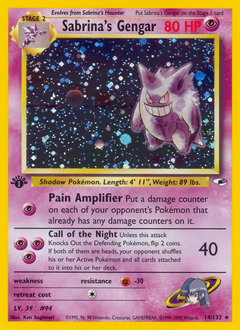
Look behind Gengar. The Japanese holo puts it in a dark, misty landscape. Collectors often describe that background as a graveyard with cross-shaped headstones; on our scan it is too murky to make out, so judge for yourself. The English holo swaps all of it for a sky full of stars, and Gengar ends up floating in space.
Grimer: A Wandering Gaze


Grimer peeks out of a drain as a schoolgirl walks past. In the Japanese print, its pupils sit at the top of its eyes, looking up, and with her skirt right there, you can see the problem. The English Team Rocket print moves the pupils to the middle, so Grimer looks straight ahead instead. A tiny edit, but once you see it, you cannot unsee it.
Kadabra: A £60 Million Lawsuit


Kadabra was not redrawn, it vanished. In 2000, spoon-bender Uri Geller sued Nintendo for £60 million, claiming the spoon-carrying Pokémon (Yungerer in Japan) was based on him without his permission. The card game quietly stopped printing it: Skyridge in 2003 had the last Kadabra card for 20 years, and players reached Alakazam with Rare Candy instead. In 2020 Geller dropped his objection, and Kadabra finally came back in 2023’s 151.
Why were these cards changed?
We could not find an official explanation for most of these changes, but line them up and the pattern is easy to see. Gambling became an arcade, a weapon aimed at the player was pointed away, art that showed too much was replaced, and a design that drew criticism for echoing racist caricatures was recolored. Kadabra is the one exception: it was not changed for an audience at all, it was pulled after a lawsuit.
From 1999 to 2003 the English cards were made by Wizards of the Coast, and The Pokémon Company International took over after that. Most of these changes happened on Wizards’ watch, but not all of them.
It is also not only a 90s thing. Magmortar’s change came in 2012, more than a decade after the first English sets.
Questions collectors ask
Which Pokémon card was banned?
Kadabra is the famous one. After Uri Geller sued Nintendo in 2000, saying the spoon-bending Pokémon was based on him, Kadabra was left out of the card game. Skyridge in 2003 had the last Kadabra card for 20 years, until it returned in 151 in 2023.
Why is Jynx purple on English cards?
Jynx was originally drawn with a jet-black face. After criticism in the West that the design echoed racist caricatures, it was recolored purple, and from Ruby and Sapphire onward Jynx has been purple everywhere. The English Base Set card already shows a dark purple face.
Have Pokémon cards ever been banned from tournaments?
Yes, but for gameplay, not artwork. Lysandre’s Trump Card was banned in 2015 because it let players shuffle their discard pile back into their deck again and again. Blaine’s Quiz Show was banned from the 2019 World Championships because attack names are translated differently in each language, so its guessing game was not fair.
Are the Japanese originals the uncensored versions?
For the nine cards on this list, yes. Each Japanese card shows the art as it was first printed, before the English release changed it.
Can you still buy the original Japanese cards?
Yes. They were regular releases in Japan and still turn up on the secondhand market. Each card’s page on Card Codex has its current price.
Know one we missed?
If you have a censored or altered card we did not cover, we would love to see it. And if this is your kind of rabbit hole, our list of the cutest Pokémon cards ever printed is built the same way: the art first, with the card’s page a tap away.