
Ever held two Pokémon cards and felt like one was… different? You’re not just imagining things. Across hundreds of Pokémon sets and tens of thousands of unique cards, you’d think the one thing we could count on is them all being the same size. For the most part you’d be right, but the exceptions are where the real fun begins.
Think of it like this: your standard Pokémon card is your trusty Pikachu, but sometimes you run into a towering Alolan Exeggutor or a tiny Joltik. Understanding these size differences isn’t just trivia. It decides which sleeves you buy, which toploaders actually fit, and whether that card you just bought is real.
So let’s get out our digital rulers.
The Pokémon Card Standard Size
A standard Pokémon card measures 63mm x 88mm, or 2.5 inches x 3.5 inches (width x height). You will sometimes see this written as 63.5mm x 88.9mm, which is just the exact arithmetic conversion of the inch figure. If you put a ruler on an actual card, 63 x 88 is what you’ll get.
This size is the bedrock of the Pokémon TCG. It’s the expected size for everything from your common Pidgey to that ultra-rare chase card you finally pulled. Every sleeve, binder page and toploader on the market is designed around it, which is why you can sleeve a 1999 card and a 2026 card in the same pack of sleeves. Knowing these basic dimensions is the first step in learning how to read a Pokémon card like a pro.
A few other numbers worth knowing while we’re here:
- Thickness: around 0.30mm to 0.32mm, which is roughly 12-point cardstock.
- Weight: a standard card weighs somewhere between 1.8g and 2g. Holos and special art rares tend to sit at the heavier end.
- Aspect ratio: 5:7. At 300 DPI that works out to 750 x 1050 pixels, which is the figure you want if you’re building a card template.
Track Your TCG Collection
Create your free Card Codex account to monitor card prices, view real-time market trends, and analyse your portfolio’s growth.
Start Tracking Now — It’s FreePokémon Card Sizes at a Glance
| Format | Millimetres | Inches | Where you’ll find it |
|---|---|---|---|
| Standard card | 63 x 88 | 2.5 x 3.5 | Every booster pack, every set |
| Box topper | around 90 x 126 | around 3.5 x 5 | Sealed booster boxes, some promos |
| Jumbo (2020 onwards) | around 136 x 187 | around 5.4 x 7.4 | Premium and Ultra Premium Collections |
| Jumbo (pre-2020) | around 145 x 200 | around 5.7 x 7.9 | Older premium boxes, event prizes |
| CoroCoro oversized | around 145 x 205 | around 5.7 x 8.1 | Japanese magazine promos |
Jumbo dimensions have never been rigidly standardised, so treat the oversized figures as close approximations rather than exact specs. Bulbapedia’s catalogue of jumbo cards shows just how much the format has drifted over the years, ranging from barely larger than a normal card to over eight inches tall. If you’re buying protection, measure your card first.
Are Pokémon Cards the Same Size as Other TCGs?
Mostly, yes. Pokémon shares the 63 x 88mm standard with Magic: The Gathering, most sports cards and the majority of modern trading card games. That’s why a pack of generic standard sleeves works across all of them.
The notable exception is Yu-Gi-Oh!, which uses a smaller card at roughly 59 x 86mm. Yu-Gi-Oh! sleeves are usually sold as “small” or “Japanese size” and will be too tight for a Pokémon card. If you play both games, buy them separately.
Going Big: The Oversized Exceptions
While the overwhelming majority of cards stick to the standard, The Pokémon Company loves a curveball with special releases and promotional items. These odd-sized cards are often what make opening a premium collection box so exciting.
Box Toppers
Often found as an incentive inside a sealed booster box, box toppers sit between standard and jumbo at around 90mm x 126mm. Confusingly, “box topper” describes where the card came from rather than how big it is. Plenty of box toppers over the years have been ordinary standard-sized holos.
Jumbo Cards
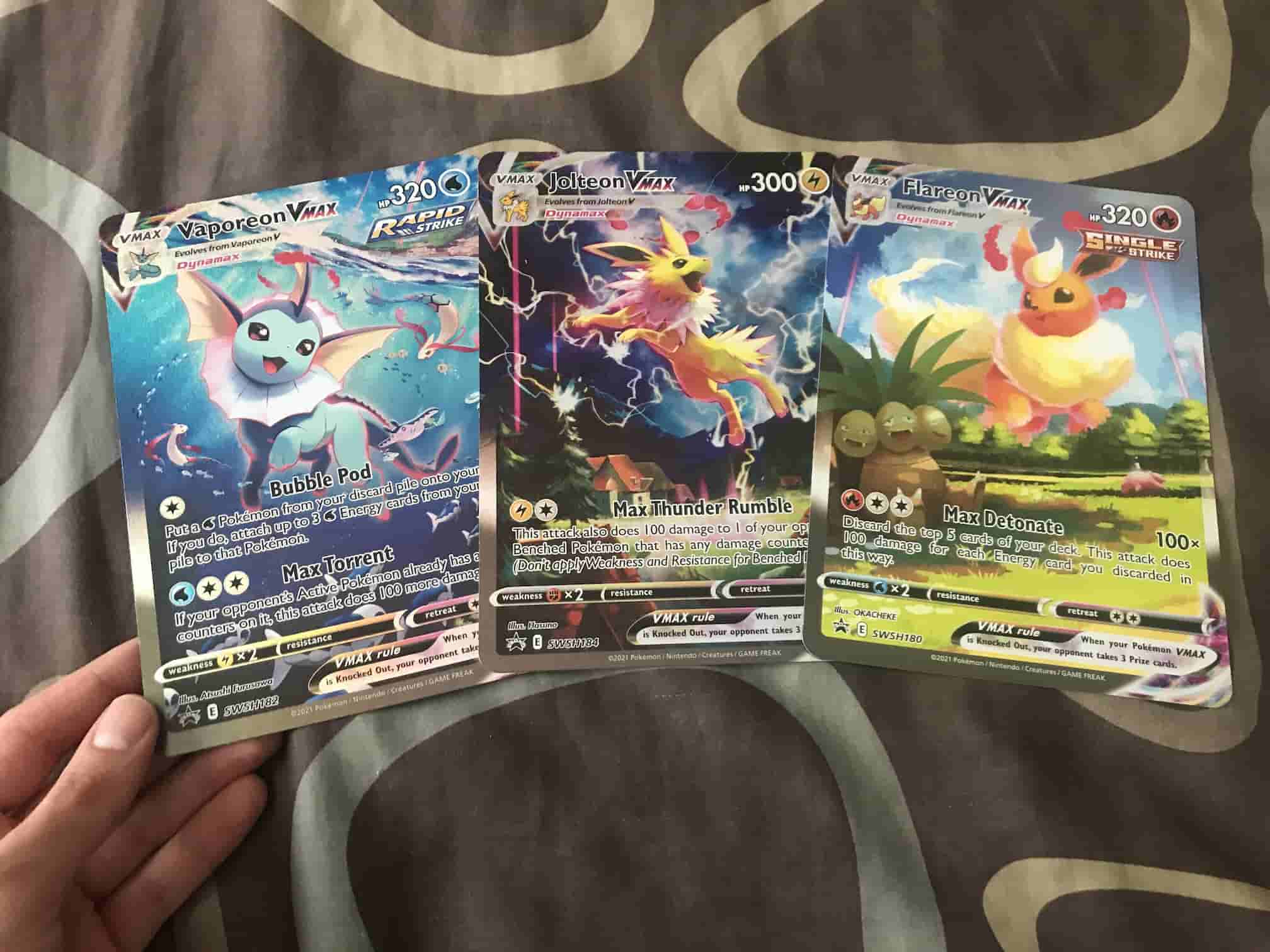
Jumbo cards, sometimes called oversized cards, are strictly promotional and were never intended for play. They turn up in Premium Collections, Ultra Premium Collections, event giveaways and retailer promotions.
There are broadly two eras. Jumbos printed from around 2020 onwards are a little smaller and squarer, at roughly 136mm x 187mm. Jumbos printed before that tend to be taller and narrower, at roughly 145mm x 200mm. If you collect across both eras, that difference matters when you’re buying sleeves or frames, because a holder sized for one will not properly fit the other.
CoroCoro Oversized Cards
The largest of the lot are the Japanese promotional cards tied to CoroCoro Comic, which reach around 145mm x 205mm. These were typically included with magazine issues or subscriptions, and they’re difficult to find outside Japan.
Are Japanese Cards Sized Differently?
No. Japanese and English Pokémon cards share the same 63 x 88mm dimensions, so they’re fully interchangeable for sleeves, binders and storage. This trips a lot of people up because Japanese Yu-Gi-Oh! cards genuinely are smaller, and the assumption gets carried across.
What does differ is the feel. Japanese cards typically have slightly more rounded corners and use a marginally different card stock, which changes the texture and how the card handles. Print quality tends to be sharper with more saturated colours, and holo patterns often differ from their English counterparts. None of that affects the footprint.
V-UNION Cards: Four Parts of a Whole
V-UNION cards are a unique beast. A single powerful Pokémon is spread across four separate cards that form one large image when laid out together. Each individual piece is a completely standard 63mm x 88mm card with a standard back.
Importantly, that means V-UNION cards are tournament legal. You run all four parts in your deck, and once all four are in your discard pile you can combine them and put them onto your Bench as a single Pokémon. The Pokémon Company’s own rules explainer covers the details, including the requirement that all four parts come from the same set and artist.
The V-UNION Special Collections also shipped a separate oversized print of the assembled artwork, which is where some of the confusion about their size comes from. That jumbo version is display-only. The four playable cards are standard. They remain one of the most interesting types of Pokémon cards to collect.
What Size Sleeves and Toploaders Do You Actually Need?
This is the real reason most people look up card dimensions, so here are the numbers.
- Standard sleeves measure roughly 66mm x 91mm. That’s a few millimetres of clearance on each side, which is what lets you get the card in without bending a corner.
- Perfect fit sleeves measure roughly 64mm x 89mm. These sit tight against the card and are designed to go underneath a standard sleeve, a setup collectors call double sleeving.
- Toploaders for raw cards are 3 inches x 4 inches. The standard thickness rating is 35pt, which comfortably fits a sleeved standard card.
- Binder pages are almost always nine-pocket, holding nine cards per side and eighteen per page.
- Jumbo cards need dedicated jumbo sleeves and jumbo binders. Standard products will not work, and jumbo sleeves themselves vary by era, so check the listed dimensions against your card.
Manufacturer specs vary slightly between brands, so if you’re buying in bulk it’s worth checking the dimensions printed on the packaging rather than assuming.
Why Does Size Matter? More Than You’d Think
- Protection and storage. A card that’s loose in its sleeve rattles around and picks up edge wear. A sleeve that’s too tight bends corners on the way in. Correctly sized protection is step one in sorting and organising your Pokémon cards for the long haul.
- Spotting fakes. Counterfeiters get fine details wrong, and dimensions are one of the easiest checks you can run at home. If a card feels too big, too small, oddly light or unusually rigid, put it next to a card you know is real. Weight is a useful second check, since a standard card should land between 1.8g and 2g. Here’s how to spot a fake Pokémon card using size and everything else.
- Game legality. Only standard-sized cards are legal for organised play. Oversized promos and jumbos are display pieces and can’t go in a competitive deck, no matter how good the artwork is.
- Understanding errors. Legitimate cards occasionally leave the factory with dimension problems. These are miscuts, where the card is off-centre or shows a slice of the card next to it on the sheet. The value of miscut Pokémon cards varies wildly depending on how dramatic the error is.
Pokémon Card Size and Dimensions FAQ
Are all vintage Pokémon cards the same size as modern ones?
Yes. The 63mm x 88mm standard has been consistent since the very first Base Set. That’s why you can sleeve a 1999 Charizard and a 2026 Charizard in the same perfect-fit sleeve.
What is the thickness of a Pokémon card?
Around 0.30mm to 0.32mm, roughly equivalent to 12-point cardstock. Thickness is another useful fake-detection signal, since counterfeits often feel noticeably flimsier or unusually stiff.
How much does a Pokémon card weigh?
Between 1.8g and 2g for a standard card. Holos and special art rares typically weigh slightly more than commons. A jeweller’s scale is a cheap and surprisingly effective authentication tool.
Will standard sleeves fit all my Pokémon cards?
They’ll fit every standard English, Japanese and international card. Jumbo cards, box toppers and other oversized promos all need their own sleeves and binders.
Are Pokémon cards the same size as Magic or Yu-Gi-Oh! cards?
Same as Magic: The Gathering, which also uses 63mm x 88mm. Different from Yu-Gi-Oh!, which is smaller at roughly 59mm x 86mm and needs its own sleeves.
Are box topper cards always jumbo-sized?
No. “Box topper” describes a promotional card included in a sealed booster box, not a specific size. Some have been standard-sized holos, others have been genuinely oversized.
Can a card’s dimensions affect its grade?
Not directly. A grading company won’t mark a card down simply for being an oversized promo. What dimensions do affect is centring, which is a core part of every grade and measures how the artwork sits relative to the card’s edges. A miscut card will score poorly on centring. If you’re planning to submit anything oversized, check the grading company’s current submission guidelines first, since acceptance and slab sizing vary by service.