
Updated September 2026
Have you ever left a beloved belonging by the window for too long, only to find it looking like a ghost of its former self? We’ve all been there! But what if I told you that some Pokémon trainers are doing this on purpose to their precious cards?
That’s right! Welcome, fellow enthusiast, to the wild and fascinating trend of “sunbleaching” (or “sunfading”) Pokémon cards. What started as a handful of odd before-and-after photos has grown into its own little corner of the hobby, complete with weekly progress videos, faded customs selling as art, and plenty of heated comment sections asking the same question: cooler, or ruined?
But why on earth would anyone intentionally blast their collection with the sun’s rays (basically a real-life Solar Beam)? And how does it even happen? Let’s dive into the sunny depths of this trend and find out!

The Science of Sun-Sorcery: How Does This Actually Work?
Before we get into the why, let’s tackle the how. That ghostly fade isn’t magic; it’s a scientific process called photodegradation. Think of it as a battle at the molecular level!
The ink on a Pokémon card gets its color from molecules called chromophores. When sunlight hits the card, it isn’t just throwing visible light at it. It’s also firing invisible, high-energy ultraviolet (UV) radiation. UV is the heavy hitter here: it breaks chemical bonds inside those chromophores, and once they’re altered they can’t absorb and reflect light the way they used to. The result? Colors that look washed out, or “bleached.”
Here’s the bit most guides skip, though: UV isn’t working alone. The Canadian Conservation Institute notes that visible light can cause photochemical damage too, just with less punch than UV. That’s why a card taped behind a window still fades, even though ordinary window glass filters out most UVB. And whatever the sun takes, it keeps. Museum conservators treat light damage as cumulative and irreversible, so there’s no “undo” button on this one.
Why Some Colors Vanish First
Different colors fade at different rates, and this is where it gets fun. Pokémon cards are printed with the classic four process inks: cyan, magenta, yellow and black. They are not equally tough. Typical fade testing on standard process inks, summarized by The Print Guide, found process yellow and magenta started fading in under a month of outdoor exposure, while process cyan held out for around two years and black lasted well beyond a year.
So it’s less about reds and yellows “absorbing more energy” and more about pigment chemistry. Reds are built from magenta and yellow, the two weakest links, so they collapse first. Cyan hangs around like a stubborn Snorlax blocking the road. That’s why so many sunfaded cards end up with that icy, blue-silver glow instead of just going plain white.
| Ink | Where you’ll see it | How it handles the sun | What happens to your card |
|---|---|---|---|
| Yellow | Yellow borders, Electric types, warm backgrounds | Fades fast | Borders go pale and yellows are the first to disappear |
| Magenta | Pinks, purples, and (mixed with yellow) reds and oranges | Fades fast | Fire types and pink details lose their punch early |
| Cyan | Blues, plus the blue half of greens and purples | Slow and stubborn | Blue tones linger, giving that icy “ghost” tint |
| Black | Text, outlines, shadows | Very stable | Card text and linework stay readable long after the art fades |
Holo cards add another twist. The shine on a holo comes from a metallic foil layer, and sunlight doesn’t dull that the way it strips ink. As the colors printed over the foil thin out, more of the shimmer shows through, which is exactly where that “premium, metallic” look people rave about comes from.


Track Your TCG Collection
Create your free Card Codex account to monitor card prices, view real-time market trends, and analyse your portfolio’s growth.
Start Tracking Now — It’s FreeWhy Are People Doing This?
It might seem like madness to intentionally damage a Pokémon card, especially with some fetching prices that could rival a small treasure hoard. But the reasons behind this trend are as varied and interesting as the Pokémon themselves.
Taking the “shiny” card to the next level
For many, sunbleaching is all about aesthetics. Think of it as creating your very own, ultra-unique “shiny” Pokémon. Some creators take that literally, fading a yellow Pokémon week after week and posting updates as it slowly drifts toward its shiny colors. It’s the slowest evolution in the franchise, and people are glued to it.
Knowing which inks fade first also tells you who transforms best. A fire-red Charizard can turn into a pale, spectral dragon, and fiery birds are a community favorite for exactly that reason. A deep-blue Blastoise, on the other hand, is stubborn. Thanks to that tough cyan ink, it tends to keep its blue long after its warmer neighbors have gone full ghost.
This creates a one-of-a-kind card that stands out in a collection. It’s a way for collectors to put a personal, artistic spin on their cards, making something that is uniquely theirs. In a world of mass-produced collectibles, a little bit of personal flair can be as exciting as finding a secret rare in a booster pack!
The Joy of Custom Art
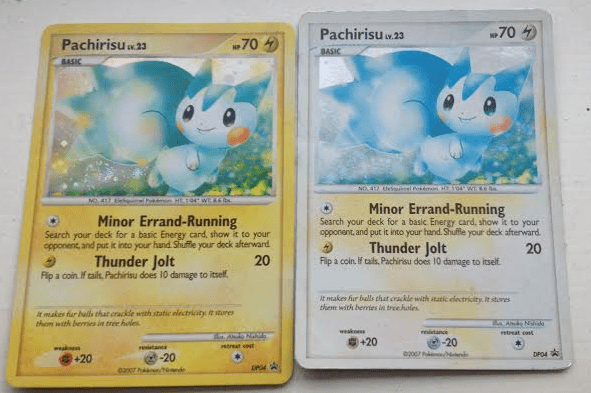
Beyond a simple all-over fade, some creative trainers are taking it to the next level. By using tape or other materials to mask off specific parts of the card before leaving it in the sun, they can create incredible custom designs. Imagine a Venusaur where the vibrant pink flower stays bright against a pale, sun-bleached body (and since magenta is one of the first inks to go, that masked flower really pops). The effect can be particularly striking on foil cards, creating a new dynamic between the faded art and the shimmering finish of a holo vs. reverse holo.
This technique turns a simple Pokémon card into a tiny canvas. It’s a form of alteration art, much like the popular 3D-cut cards you may have seen. It’s not about the card’s monetary value anymore, but about its value as a piece of unique, fan-made art.
A particularly popular trend within this niche is targeting just the yellow border. By carefully masking the entire center of the card and leaving only the border exposed, patient artists can fade the yellow to a clean, pale silvery-white. It’s almost like giving your favorite Pokémon a custom frame!
This one has only become more popular since English cards swapped yellow borders for silver, starting with the Scarlet & Violet series in March 2023, to match Japanese cards. Every English card up to and including Crown Zenith still wears yellow. If you’re building a binder that mixes eras, those bright frames can stick out like a Psyduck at a Gyarados convention, and fading the border is one way collectors make older cards sit more comfortably next to the silver-bordered era.
A Misguided Treasure Hunt?
Here’s where we need to be crystal clear: sunbleaching a Pokémon card is considered damage. While it might look cool, understanding what makes a Pokémon card valuable is key, and this process will significantly decrease its official value. There is a common misconception that these faded cards could be passed off as rare “printing errors,” like a card that missed an ink layer during production. This is not the case. Experts can easily tell the difference between sun damage and a genuine error, such as a miscut Pokémon card, and learning how to avoid Pokémon card scams is an important skill for any collector.
And if you’re hoping a grading slab will bless your creation, think again. PSA’s grading standards list discoloration as a defect that pushes cards toward the bottom of the scale, and PSA won’t give a numeric grade to cards showing signs of tampering such as recoloring. There’s no official “sunfaded” label, so at best you’re gambling a grading fee on a low number. It’s the same logic that makes cleaning a card before grading such a risky game.
So, if you’re thinking of doing this to your secret rare Charizard to try and triple its value, think again! You’re more likely to turn a legendary Pokémon into the collecting equivalent of a Magikarp.
Wait, People Are Actually Buying These?
Here’s the twist nobody saw coming: sunfaded cards have found a market. Not as “error” cards, but as art. Search eBay for sun bleached Pokémon cards and you’ll find listings with gallery-style names like “Stained Glass” and “Ember,” often bragging about how long the card spent in the sun. Some of them clocked well over a year on the windowsill!
The trend got a real jolt when a sun-faded Galarian Moltres went viral on social media, and some collectors say they picked up cheap copies and flipped faded versions for several times what they paid. It’s a perfect candidate, too: all that deep red and purple is made of exactly the inks that fade fastest.
My take? If a faded card genuinely makes you smile, buying it as a piece of art is totally fair. Just go in with your eyes open. You’re paying for one artist’s eye and patience, not for a collectible with an official price guide, and the next viral fade could make yours look ordinary overnight. If you’re selling your own creations, say clearly in the listing that the fade is intentional. Our guide on where to sell Pokémon cards can help you pick the right place to list them.
How to sunbleach your cards
Feeling a bit daring? Intrigued by the idea of creating your own ghost-type Pokémon card? If you’re ready to experiment, here’s a guide to get you started.
Disclaimer: A Word of Warning!
Before we begin, let’s repeat the crucial mantra: This is a permanent process that is considered damage. Do NOT try this on valuable cards or cards you have a sentimental attachment to. This is purely for fun and artistic expression. Before you begin, you should have a good grasp of Pokémon card rarities to make sure you don’t accidentally ruin a hidden gem. Think of it as an irreversible evolution for your card, so choose your Pokémon wisely!
What You’ll Need
- A Pokémon Card: If you’re wondering what to do with Pokémon card bulk, this is the perfect project for your common cards and duplicates!
- A Penny Sleeve: A simple, clear sleeve to keep dust and moisture off the card. Don’t think of it as sunscreen, though. A regular penny sleeve isn’t sold as a UV filter, so the light still gets through.
- A Window with Direct Sunlight: The more sun, the faster the process. Here in the Northern Hemisphere, a south-facing window gets the most direct sun through the day.
- Tape (Optional): Opaque tape, like painter’s tape, if you want to mask off parts of the design.
- Patience: This isn’t a quick process!
Steps to follow
- Choose Your Pokémon: Select the common card you’re willing to send on this solar adventure. Want the most dramatic change? Pick one with lots of reds, pinks and yellows.
- Sleeve It Up: Place your card into a clean penny sleeve. This will protect it from any dust or condensation on the window.
- Get Creative (Optional): If you want to make a design, now’s the time! Use small pieces of tape on the outside of the penny sleeve to cover any areas you want to protect from the sun. The ink under the tape will stay vibrant.
- Find Your Spot: Tape the sleeved card to the inside of a window that gets several hours of direct sunlight each day. Skip the car windshield, though. Most modern windshields are laminated and block almost all UV, so you’d be baking your card rather than fading it. And a parked car in summer is brutal: in an Arizona State University study, dashboards averaged 157°F after just an hour in the sun. That kind of heat can warp cards and sleeves long before the colors change.
- Keep It Indoors: The patio table looks tempting, but rain, dew and humidity will wreck a card long before the sun finishes the job.
- Wait for the Magic: This is the hardest part. Depending on the strength of the sun and the colors on the card, you’re looking at anywhere from a few weeks for a light tint to many months for a full ghostly fade. Remember, yellows and reds go first, and blues hold on the longest!
How Long Does It Take?
Honestly? Longer than you think. A sunny summer window can visibly wash out yellows within a few weeks, but a full, ghost-white transformation can take many months, and plenty of creators post updates stretching past a year. Winter sun, cloudy climates and UV-filtering windows all slow things down.
Check on your card every week or so and snap a photo in the same spot each time. It’s the only way to really see the progress, and a before-and-after series is half the fun. Once it has reached your desired level of “ghostliness,” take it down and admire your custom creation!
Sun-Proofing the Cards You Actually Love
Now flip everything we just learned on its head. If the sun can do all that to a bulk card on purpose, it can do it to your favorite holo by accident. Binder pages facing a window, a slab on a sunny shelf, a framed card near the patio door: they’re all slow-motion sunbleaching experiments you never signed up for.
The fix is simple. Keep displayed cards out of direct sunlight, and use UV-protective cases or frames for anything you want to show off. We’ve covered the options in our guide on how to display your holy grails with UV protection. Fading also counts against a card’s condition, so it’s worth knowing how Pokémon card conditions are judged before you decide where your best cards live.
Not sure which cards deserve the shady side of the shelf? Add them to your Card Codex collection and you’ll always know which pulls are worth protecting.
Is Sunbleaching Worth It?
So, should you join the ranks of the sunbleachers? If you’re a creative person who loves to customize your collection and you have a stash of common cards you’re happy to experiment with, it can be an incredibly fun and rewarding project. It offers a new way to interact with the hobby and create something truly unique, especially if you get your kids involved.
However, if you’re a collector focused on preserving the mint condition and monetary value of your cards, this is a trend to avoid like a surprise encounter with a full team of Zubats.
Ultimately, the beauty of the Pokémon TCG is the diverse community and the many ways there are to enjoy it. Whether you’re a competitive player, a master collector, or a sunbleaching artist, what matters most is the passion and fun you get from it.
So go ahead, catch ’em all… and maybe give one or two a nice, long sunbathe!