
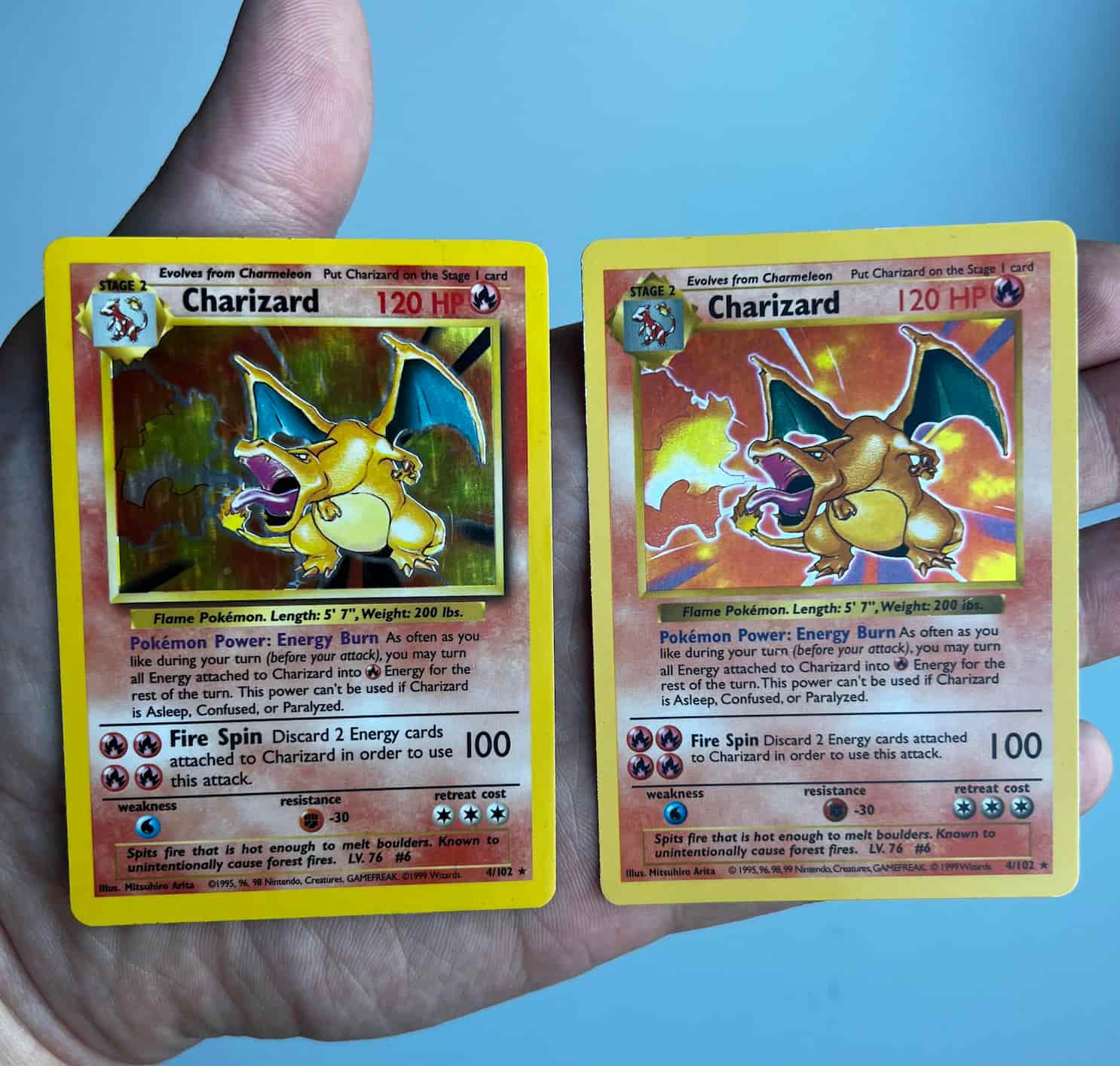
Ever pulled out your old Pokémon cards wondering if you struck gold? That stack of childhood memories might be hiding something valuable, specifically the elusive “shadowless” cards from the original Base Set.
These aren’t just regular Pokémon cards with a fancy name. Shadowless cards represent a brief printing window that created some of the most sought-after collectibles in the hobby. While you’ve probably seen the term floating around eBay listings with eye-watering price tags, most collectors don’t actually know what makes these cards special or how to spot them.
And with the Pokémon TCG celebrating its 30th birthday this year, there has never been a better excuse to dig out the old binder.
So, What in Arceus’s Name is a “Shadowless” Pokémon Card?
Picture this: it’s January 1999, the Pokémon craze is just starting to explode in the United States, and Wizards of the Coast is printing the very first English Pokémon cards, the Base Set. In these initial print runs, the artwork on the Pokémon cards had a very flat, clean look.
Now, take a look at a later Pokémon card. See that subtle, dark shading along the right-hand edge and bottom of the character’s art box? That’s a “drop shadow,” added to later printings to make the art pop.
You guessed it: Shadowless cards are from the first couple of print runs of the English Base Set and are missing this drop shadow. It’s like having a first-edition book before the publisher decided to tweak the cover design. These cards are a snapshot of the Pokémon TCG’s earliest moments, a piece of its history before it became the global phenomenon we know today. If you want to see where Base Set sits in the bigger picture, our short history of every Pokémon TCG era walks you through it.
Track Your TCG Collection
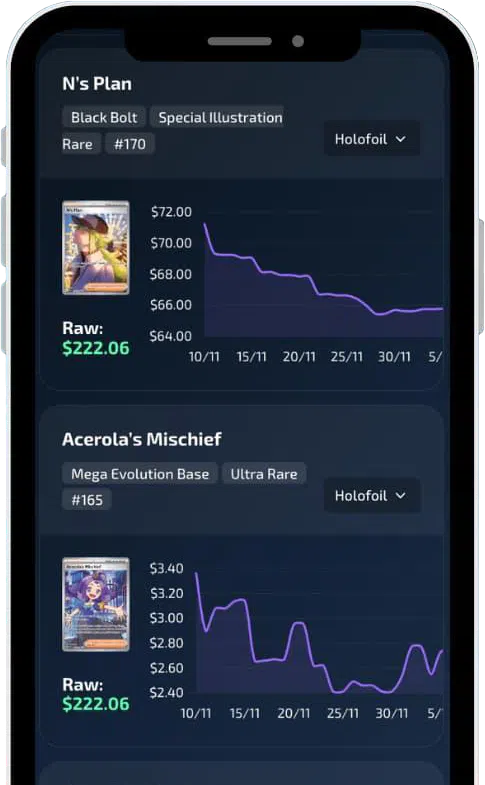
Create your free Card Codex account to monitor card prices, view real-time market trends, and analyse your portfolio’s growth.
Start Tracking Now — It’s FreeSpotting a Shadowless Card
Think you might have one of these rare treasures? Grab your detective hat, and let’s examine the evidence. And if you need a refresher on the basic layout of a Pokémon card, our guide on how to read a Pokémon card from top to bottom is a great place to start.
1. The Case of the Missing Shadow
This is the most obvious clue. Look at the border of the Pokémon’s artwork. If the right and bottom edges are clean and have no shadow, you might be holding a shadowless card. If there’s a distinct grey shadow running down the right side, you’ve got a card from the “Unlimited” print run, which is far more common.
2. A Lighter Touch on the HP
Check out the “HP” text at the top right of the card. On a shadowless card, the font is noticeably thinner and more delicate. Unlimited cards have a bolder, thicker font for the HP. It’s a subtle difference, but once you see it, you can’t unsee it!
3. The Copyright Fine Print
This is the definitive test, especially for Trainer and Energy cards, which never had a drop shadow. At the very bottom of the card, you’ll find the copyright information. A shadowless card’s copyright line will include the year “99”:
© 1995, 96, 98, 99 Nintendo, Creatures, GAMEFREAK. © 1999 Wizards.
The later Unlimited cards dropped the “99” from that first set of dates. It’s a tiny detail that makes a world of difference in value! Beckett’s grading team rates that extra 99 as the most reliable tell on the card, partly because it survives wear far better than the visual clues do.
Bonus tip that has become very handy lately: the modern anniversary reprints of Base Set cards don’t carry the Wizards of the Coast line at all. No “© 1999 Wizards,” no chance it’s a 1999 card. More on those lookalikes further down.
If you’re looking to understand the different types of cards in more detail, we have a great article on the different types of Pokémon cards and how to recognize them.
| Feature | Shadowless | Unlimited |
|---|---|---|
| Art box | Flat, no shadow on the right edge | Grey drop shadow on the right and bottom |
| HP text | Thin and delicate | Bold and heavier |
| Copyright line | © 1995, 96, 98, 99 Nintendo… | © 1995, 96, 98 Nintendo… |
| Edition 1 stamp | No (if it has one, it’s 1st Edition) | No |
Works for every English Base Set card. Trainer and Energy cards have no art box shadow, so lean on the copyright line for those.
Why Do These Cards Even Exist?
The story of shadowless cards is a tale of design evolution. When Wizards of the Coast first brought the Pokémon TCG to the English-speaking world, they were still finalizing the look of the cards. The initial design was shadowless.
After the first couple of print runs, the cards picked up a few cosmetic tweaks, most likely to give them a bit more visual punch: the drop shadow arrived and the HP got bolder. Those changes carried forward into the “Unlimited” print run and every English set that followed, which is exactly why shadowless cards are such a fascinating glimpse into the game’s origins.
And “Unlimited” really does mean unlimited. In PSA’s Base Set collecting guide, vintage expert Scott Pratte reckons there were around seven Unlimited print runs in total. Seven! No wonder those copies are everywhere and shadowless ones are not.
Are Shadowless Cards a Big Deal?
In a word: yes! Because they were only produced for a short period before the Unlimited set flooded the market, shadowless cards are significantly rarer.
You can actually see it in the grading numbers. PSA has graded more than 100,000 Unlimited Base Set Charizards. For the shadowless version, PSA’s own figures put the total at roughly 14,500. That’s about seven Unlimited copies for every shadowless one that has been through a grader. It isn’t a perfect measure of how many were printed, but it tells you plenty.
The value of a shadowless card depends on a few key factors:
- The Pokémon: As you’d expect, iconic Pokémon like Charizard, Blastoise, and Venusaur command the highest prices.
- The Rarity: Just like in any set, the rarity symbol in the bottom corner matters. A rare card (with a star symbol) will be worth more than a common (circle) or uncommon (diamond). For a deep dive into what these symbols mean, check out our post on Pokémon card rarities explained.
- The Condition: A pristine, mint-condition card will be worth exponentially more than one that’s been through the playground wringer. Only a few dozen shadowless Charizards have ever earned a PSA 10. Getting a card graded by a professional service like PSA can certify its condition and significantly boost its value, and our breakdown of how much it costs to grade your cards will help you decide if it’s worth it.
So What Is a Shadowless Card Worth in 2026?
Let’s talk numbers, because I know this is the bit everyone scrolls to. Here’s how the three versions of Base Set Charizard stack up at the same grades.
| Printing | PSA 7 | PSA 9 | PSA 10 |
|---|---|---|---|
| Unlimited | About $1,100 | About $4,200 | About $14,200 |
| Shadowless | About $3,400 | About $10,900 | About $61,600 |
| 1st Edition | About $23,400 | About $67,700 | About $414,000 |
Card Codex market prices for Base Set Charizard 4/102, September 2026, in US dollars, rounded. Vintage prices move fast, so always check live sales before buying or selling.
So a shadowless Charizard runs roughly two and a half to four times the price of an Unlimited copy in the same grade, with the biggest jump right at the top. You can track every version on our Base Set Charizard page.
And the very top of the tree? In December 2025, a PSA 10 1st Edition Charizard sold for $550,000 at Heritage Auctions, smashing the card’s previous public auction record. That’s house money. Literally.
No Charizard in your stack? Don’t panic. Base Set has 16 holo rares, and the shadowless premium applies right across them, just from a lower starting point. Beckett makes the point that even mid-grade shadowless holos hold real value, which is not something you can say about most Unlimited copies.
Who knows, you might even have a shadowless card tucked away in your old collection! It might be time to sift through that Pokémon card bulk and see if you have any hidden treasures. Some collectors even strive to complete a full master set of shadowless cards, a truly impressive feat! And if you find a shadowless card with a printing error, like a miscut card, you could be looking at an even more valuable collector’s item.
Got a whole shoebox to get through? Point our free card scanner at each one to pull up the card and its prices in seconds, then do the shadow check yourself.
1st Edition vs. Shadowless vs. Unlimited
Let’s clear up a common point of confusion. There are three main versions of the English Base Set cards:
- 1st Edition: These are from the very first print run and have a special “Edition 1” stamp on the left, just below the art box. Almost every 1st Edition Base Set card is also shadowless. These are the rarest and most valuable of the bunch.
- Shadowless: These are from the print run that came immediately after the 1st Edition. They don’t have the 1st Edition stamp but still have all the shadowless characteristics we’ve discussed.
- Unlimited: This is the most common version of the Base Set. These cards have the drop shadow and the bolder HP font.
So, the hierarchy of rarity and value goes: 1st Edition > Shadowless > Unlimited. Prices follow the order they were printed in, which is exactly how PSA’s Base Set guide describes it too.
The Machamp Exception
Every rule needs a troublemaker, and in Base Set it’s the one with four arms. Machamp was the holo in the 2-Player Starter Set rather than a booster pack pull, and as PSA’s guide points out, every legitimate Base Set Machamp carries a 1st Edition stamp. There’s no stamp-free version at all.
The earliest copies are shadowless, but plenty of 1st Edition Machamps have the drop shadow, and because those starter decks were everywhere, it’s the one 1st Edition holo that doesn’t command a big premium. So if you find a 1st Edition Machamp with a shadow, it isn’t a fake or an error. It’s just Machamp being Machamp.
Shadowless Lookalikes: The Reprints That Fool Everyone
Here’s where a lot of people get their hopes up. That Base Set Charizard art has been reprinted so many times that owning “the Charizard picture” tells you almost nothing on its own. If your card has any of the features below, it’s a reprint, and it isn’t shadowless, no matter how clean that art box looks.
| Reprint | Year | How to tell |
|---|---|---|
| Base Set 2 | 2000 | A small “2” with a Poké Ball as the set symbol, and card numbers out of 130 |
| Legendary Collection | 2002 | Its own set symbol, and card numbers out of 110 |
| Evolutions | 2016 | A modern XY-era card frame and the Evolutions set symbol |
| Celebrations: Classic Collection | 2021 | A little 25th anniversary logo in the artwork, modern foil, no Wizards copyright line |
| Pokémon TCG Classic (Charizard deck) | 2023 | Its own card numbering and a sparkly gold-toned holo pattern |
| 30th Celebration | 2026 | The 30th anniversary logo and no Wizards copyright line |
Quick rule: if there’s no Wizards of the Coast copyright line on the card at all, it’s a modern reprint, not a 1999 print.
Heads Up: The 30th Celebration Charizard
This one deserves its own warning label. Pokémon TCG: 30th Celebration launches worldwide on September 16, 2026, and The Pokémon Company has confirmed classic cards are coming back, with Base Set Charizard front and center.
The English version is a straight reprint of the original Base Set card, anniversary logo aside, and just like the 2021 Celebrations version before it, there’s no Wizards of the Coast copyright line on it. Which means I fully expect eBay to fill up with “Base Set Charizard” listings over the next few months that have nothing to do with 1999.
My take? It’s a gorgeous card and plenty of us will be chasing one. Just know what you’re buying. The 2021 reprint never dented the price of the originals, and I’d bet this one won’t either. Check the bottom of the card. If the Wizards line is missing, you’re holding a 2026 Charizard, not a shadowless one.
Found One? Protect It Before You Celebrate
If your card passes all three tests, take a breath and slide it into a sleeve and a top loader before you do anything else. Seriously. Then two things are worth your time.
Rule out a fake. A big premium makes shadowless cards a big target for counterfeiters. Compare yours against a known genuine scan of the same card, check the fonts and copyright line closely, and run through our guide on how to identify fake Pokémon cards.
Think about grading. A grade confirms the card is genuine, and PSA prints the variant right on the label, so buyers can see “Shadowless” at a glance. Shadowless holos are one of the rare cases where even a middling grade can justify the fee, but do the math on your specific card first.
But What About My Japanese Cards?
Shadowless is an English-only thing. The original Japanese Base Set cards had a different design altogether. And if you’ve got a French, German, Italian or Spanish Base Set card, it has the drop shadow even on a 1st Edition, because every other language used the shadowed layout from the start. If you’re curious about the value of cards from across the world, we have an article that tackles the question of whether Japanese Pokémon cards are worth more than English ones.
Shadowless Pokémon cards are more than just a quirky variation; they’re a tangible piece of Pokémon history. They represent the dawn of the TCG in the West and are a must-have for serious collectors.
So, go on, have another look through your old collection. You might just have a shadowless superstar hiding in plain sight.
Happy hunting!
Updated September 2026: we’ve added what shadowless cards actually sell for right now, the Machamp exception, and how to avoid mixing up the brand new 30th Celebration reprints with the real thing.