

Updated September 2026: now covers the whole Mega Evolution era so far, including Ascended Heroes, the 30th Celebration set and the upcoming Delta Reign.
If you’ve ever cracked open a Pokémon pack, you know the magic is real. The Pokémon TCG is now thirty years old, The Pokémon Company says it has produced more than 85 billion cards, and our own card database tracks tens of thousands of them. Every one of those cards belongs to an era, and every era reflects huge, deliberate changes in both the competitive game and the collecting world.
Grab a seat as we take a nostalgic journey through every major series, exploring the groundbreaking mechanics, the artwork, and the unforgettable chase cards that defined them all. We’ll finish right where the hobby stands today, in the middle of the Mega Evolution era and fresh off the 30th anniversary.
Every Pokémon TCG era at a glance
Short on time? Here’s the whole family tree in one place. The dates are for English releases, which is how most US collectors think about the eras.
| Era | English years | What it’s remembered for |
|---|---|---|
| Base | 1999 to 2000 | 1st Edition, Shadowless, the original holo Charizard |
| Gym | 2000 | Owner’s Pokémon (Brock’s, Misty’s, Blaine’s and friends) |
| Neo | 2000 to 2002 | Johto, Darkness and Metal types, Shining Pokémon |
| e-Card | 2002 to 2003 | e-Reader dot codes, Crystal Pokémon |
| EX | 2003 to 2007 | Pokémon-ex, Gold Stars, Delta Species |
| Diamond & Pearl | 2007 to 2008 | Pokémon LV.X |
| Platinum | 2009 | Pokémon SP, the Lost Zone |
| HeartGold & SoulSilver | 2010 to 2011 | LEGEND cards, Pokémon Prime |
| Black & White | 2011 to 2013 | Pokémon-EX, ACE SPEC, Full Arts |
| XY | 2014 to 2016 | Mega Pokémon-EX, BREAK, the Fairy type |
| Sun & Moon | 2017 to 2019 | Pokémon-GX, Tag Teams, Rainbow Rares |
| Sword & Shield | 2020 to 2023 | V, VMAX, VSTAR and the Alternate Art boom |
| Scarlet & Violet | 2023 to 2025 | Pokémon ex returns, silver borders, Special Illustration Rares |
| Mega Evolution | 2025 to now | Mega Evolution Pokémon ex, Mega Hyper Rares, the 30th anniversary |
Track Your TCG Collection
Create your free Card Codex account to monitor card prices, view real-time market trends, and analyse your portfolio’s growth.
Start Tracking Now — It’s FreeBase Series
This is where it all began. The Base era is the opening chapter of the Wizards of the Coast (WotC) years, when the Pokémon TCG launched in English in 1999. It’s defined by the original Base Set, Jungle and Fossil, followed by Base Set 2 and Team Rocket, which snuck in the first “Dark” Pokémon. These sets introduced the core mechanics of the game and featured the iconic original 151 Pokémon.
For collectors, this era is the most nostalgic of all, known for its simple card layouts and its scarcity. The earliest print runs featured “shadowless” cards, which lack the subtle drop shadow beside the art box found on later prints. Those, alongside the “1st Edition” stamp, are the ultimate chase items, headlined by the legendary holographic Charizard that kick-started the collecting hobby. The era’s defining look, with its bold yellow borders and art from legends like Mitsuhiro Arita, set the visual language the game still leans on today.
- English years: 1999 to 2000
- Releases tracked: 6
- Signature chase card: Charizard 4/102
Gym Series
The Gym series arrived in 2000 as another classic chunk of the WotC run. It’s made up of two iconic sets, Gym Heroes and Gym Challenge, and it was the first to introduce “Owner’s Pokémon,” featuring the partners of the Kanto Gym Leaders like Brock, Misty and Blaine, as well as Team Rocket. These cards carried the owner’s name right in the title (think “Brock’s Rhydon”).
Mechanically, Owner’s Pokémon often interacted with specific Gym Leader Trainer cards and Stadiums, which pushed players toward themed decks. The series also leaned into the villains with Team Rocket’s Pokémon. Original collectors love this era for its character-driven cards and its lore, including the infamous “Misty’s Tears,” whose Japanese artwork was deemed too risqué and completely redrawn for the English release, with a Squirtle drying Misty’s tears instead.
- English years: 2000
- Releases tracked: 2
- Signature chase card: Blaine’s Charizard 2/132
Neo Series
The Neo era ran from 2000 to 2002 and was the first to bring in the Generation 2 Pokémon from the Johto region. Across Neo Genesis, Neo Discovery, Neo Revelation and Neo Destiny, it was revolutionary for gameplay. Neo Genesis introduced two brand-new types, Darkness and Metal, along with their Special Energy cards.
The era deepened gameplay with Baby Pokémon (like Cleffa and Pichu), whose Baby Power made attackers flip a coin just to hit them. The most spectacular addition, though, was the Shining Pokémon, which arrived in Neo Revelation and Neo Destiny. These secret rares (hello, Shining Charizard and Shining Tyranitar) showed Pokémon in their alternate-colored “Shiny” forms. Their attacks demanded mixed Energy types, and they came with one of the TCG’s first “only 1 per deck” rules. Powerful, awkward and absolutely gorgeous. Very Neo.
- English years: 2000 to 2002
- Releases tracked: 4
- Signature chase card: Lugia 9/111
E-Card Series
The e-Card era ran from 2002 to 2003 and was the final series produced by Wizards of the Coast. It’s named for its compatibility with the Nintendo e-Reader accessory for the Game Boy Advance. Cards carried dot-code strips down the side and along the bottom that you could swipe to unlock Pokédex entries, mini-games and more. That forced a drastic redesign, and the result is one of the most instantly recognizable card frames the game has ever had.
The three English sets, Expedition, Aquapolis and Skyridge, are famous for being the last WotC sets and for the highly sought-after Crystal Pokémon, which debuted in Aquapolis. They’re Colorless cards with a Poké-Body that changes their type to match the basic Energy you attach, choosing from three types printed on the card. Every one of them is a secret rare, which is exactly why they became the defining chase cards of the era.
- English years: 2002 to 2003
- Releases tracked: 3
- Signature chase card: Crystal Lugia 149/147
EX Series
The EX era ran from 2003 to 2007 and was the first chapter after Wizards of the Coast’s run came to an end. It’s defined by Pokémon-ex (note the lowercase “ex”). Crucially, these were often part of an evolution line rather than always Basic Pokémon, so you frequently had to evolve into them, and they gave up two Prize cards when Knocked Out.
This era also gave us Delta Species, Pokémon with unexpected, non-native typing that added some fun, lore-based chaos to deck building. But the thing collectors truly lose their minds over is the Gold Star (Pokémon ☆). First introduced in Team Rocket Returns in 2004 with the three Hoenn starters, these ultra-rare Shiny Pokémon, several illustrated by Masakazu Fukuda, are instantly recognizable by the little gold star next to the name and the artwork that bursts out of the frame.
- English years: 2003 to 2007
- Releases tracked: 20
- Signature chase card: Torchic ☆ 108/109
Diamond & Pearl Series
The Diamond & Pearl era ran from 2007 to late 2008 and marked a real turning point. It’s most famous for Pokémon LV.X, “Level-Up” cards placed on top of an evolved Pokémon that let you keep using the attacks and Poké-Powers underneath as well as the LV.X’s own. Layered, clever and very easy to misplay at 11pm.
This era also shook up the rules. Many cards swapped the harsh “×2” Weakness for a flat bonus like “+20”, and basic Darkness and Metal Energy were printed for the first time in the Diamond & Pearl set itself, so players no longer had to scrape together four Special Energy to run those types. For collectors, the final set, Stormfront, is a highlight because it debuted the “SH” subset of Shiny Pokémon.
- English years: 2007 to 2008
- Releases tracked: 10
- Signature chase card: Glaceon LV.X 98/100
Platinum Series
The Platinum era ran through 2009 as a direct continuation of Diamond & Pearl, and it was all about competitive play. LV.X stuck around, but the headline act was Pokémon SP.
SP cards were powerful Basic Pokémon tied to a specific trainer or team, marked with a symbol after the name (G for Team Galactic, C for the Champion, so you got cards like Garchomp C). Being Basics made them fast to deploy, and a suite of dedicated Trainer cards made them faster still. The era also introduced the Lost Zone, a permanent “gone forever” pile that enabled some nasty lock and mill strategies. For collectors, the SH shiny subsets carried on through sets like Supreme Victors.
- English years: 2009
- Releases tracked: 4
- Signature chase card: Charizard G LV.X 143/147
HeartGold & SoulSilver Series
The HeartGold & SoulSilver era ran from 2010 into 2011 and celebrated a return to Johto. It’s famous for Pokémon LEGEND cards, where you needed both a top half and a bottom half in your hand, played together, to form one ultra-powerful Pokémon worth two Prize cards. Remember that trick, because it’s about to come back in a very big way.
The era also introduced Pokémon Prime, beefed-up versions of regular Pokémon with a distinctive holo treatment and art that burst past the frame. Stunning to look at, and properly playable too. The series wrapped up with Call of Legends, which featured a much-loved “SL” subset of Shiny legendaries.
- English years: 2010 to 2011
- Releases tracked: 8
- Signature chase card: Lugia LEGEND 114/123
Black & White Series
The Black & White era ran from 2011 to late 2013 and laid foundations the game still stands on. It’s most famous for introducing Pokémon-EX (capital letters this time), powerful two-Prize Basic Pokémon that dramatically sped up the game and pushed the HP ceiling through the roof.
This era also gave the Dragon type its own identity (rather than lumping it in with Colorless), and towards the end it debuted ACE SPEC Trainer cards, incredibly strong effects limited to one per deck. For collectors, Black & White is where the textured, borderless Full Art became a standard chase rarity, and where one very shiny secret-rare Charizard in Plasma Storm quietly became a grail.
- English years: 2011 to 2013
- Releases tracked: 15
- Signature chase card: Charizard 136/135
XY Series
The XY series ran from 2014 to late 2016 and was built around Pokémon-EX. It’s most famous for introducing the original M Pokémon-EX (Mega Pokémon-EX), which evolved from Pokémon-EX into cards with immense HP and attacks.
Their power came with a brutal catch: Mega Evolving immediately ended your turn, unless you had the matching “Spirit Link” Tool attached. The XY era also introduced the Fairy type to the TCG (a type that later vanished from the game) and a side mechanic called BREAK Evolution, with sideways, gold-foil cards that stacked on top of an existing Pokémon to give it new attacks.
- English years: 2014 to 2016
- Releases tracked: 24
- Signature chase card: Gengar-EX 114/119
Sun & Moon Series
The Sun & Moon era ran from 2017 to late 2019 and was defined by Pokémon-GX. These could be Basic, Stage 1 or Stage 2, carried high HP and gave up two Prize cards. Their party trick was the GX attack, a game-swinging move you could only use once per game, across your whole deck. Timing it was half the fun.
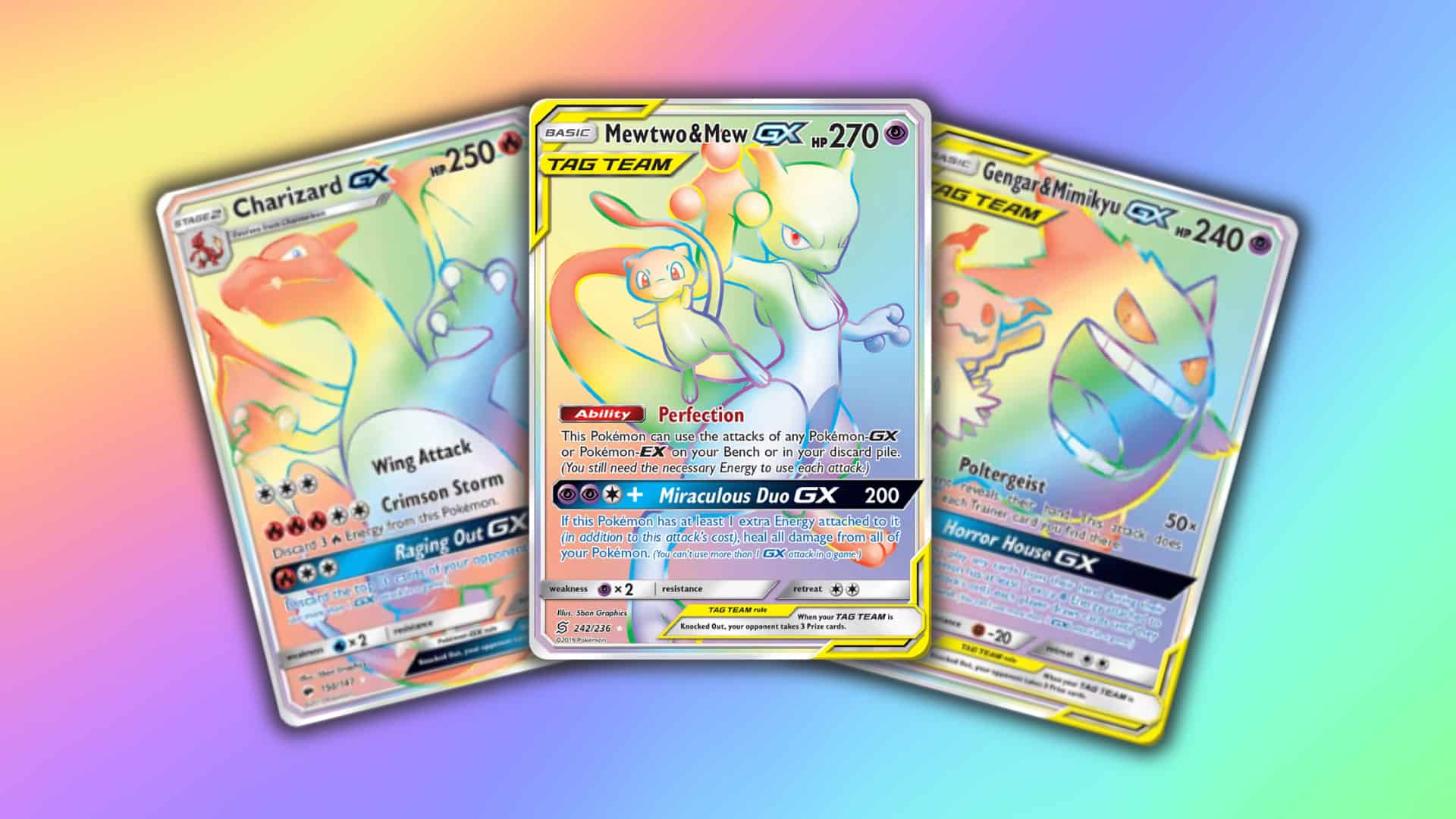
The era later escalated with Tag Team GX cards, which debuted in Team Up and squeezed two (and later three) Pokémon onto a single Basic card. Enormous HP, devastating attacks, and a three-Prize price tag if they went down. For collectors, Sun & Moon popularized the dense, shimmering Rainbow Rare and dramatically expanded the Alternate Art style, with the Tag Team alt arts still among the most wanted cards of the decade.
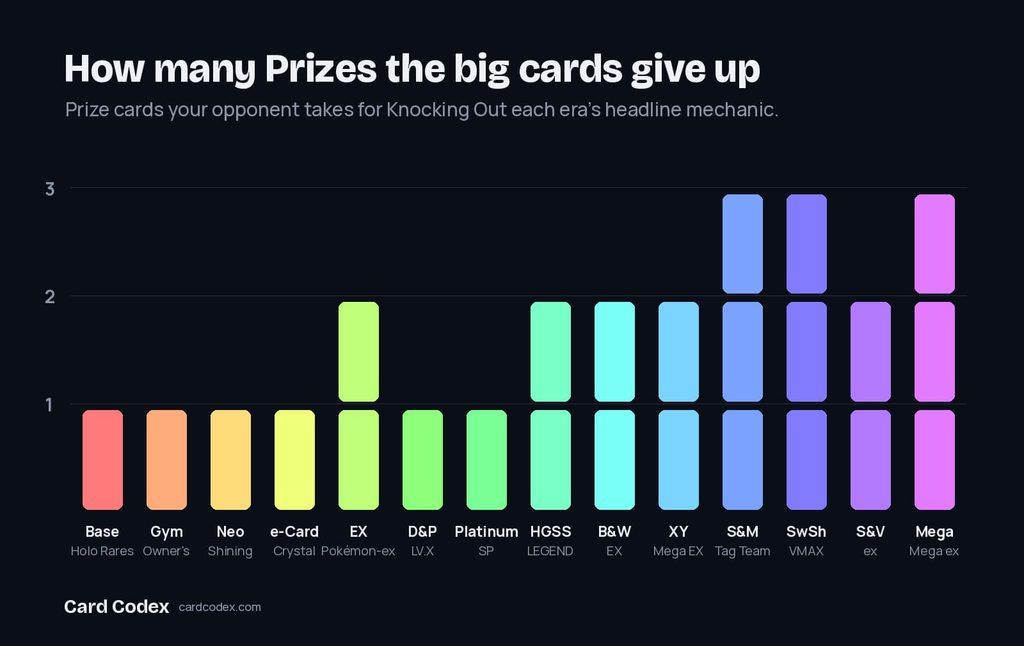
Notice how the Prize count keeps creeping up? Every era has had a headline card, and over time those cards have got bigger, scarier and more expensive to lose.
- English years: 2017 to 2019
- Releases tracked: 20
- Signature chase card: Latias & Latios-GX 170/181
Sword & Shield Series
The Sword & Shield era was a landmark period for the Pokémon TCG, running from 2020 to early 2023. It was built on Pokémon V, high-HP Basic Pokémon that gave up two Prize cards.
From there, V cards branched into two paths: the colossal VMAX (massive HP, three Prizes) and the tactical VSTAR, whose once-per-game VSTAR Power could do things like search your deck for any two cards, while only giving up two Prizes. The real legacy of this era, though, is the artwork. Sword & Shield perfected the Alternate Art, and those full-scene illustrations became the ultimate chase for modern collectors. If you know, you know: Evolving Skies and its Umbreon alt art are still the benchmark every modern set gets measured against.
- English years: 2020 to 2023
- Releases tracked: 25
- Signature chase card: Umbreon VMAX 215/203
Scarlet & Violet Series
The Scarlet & Violet era ran from 2023 to 2025 and marked a major gameplay shift, retiring the V family and bringing back the fan-favorite Pokémon ex (lowercase again, two Prizes). It also made a historic change to the look of English cards, swapping the classic yellow borders for the sleek silver borders Japan had been using.
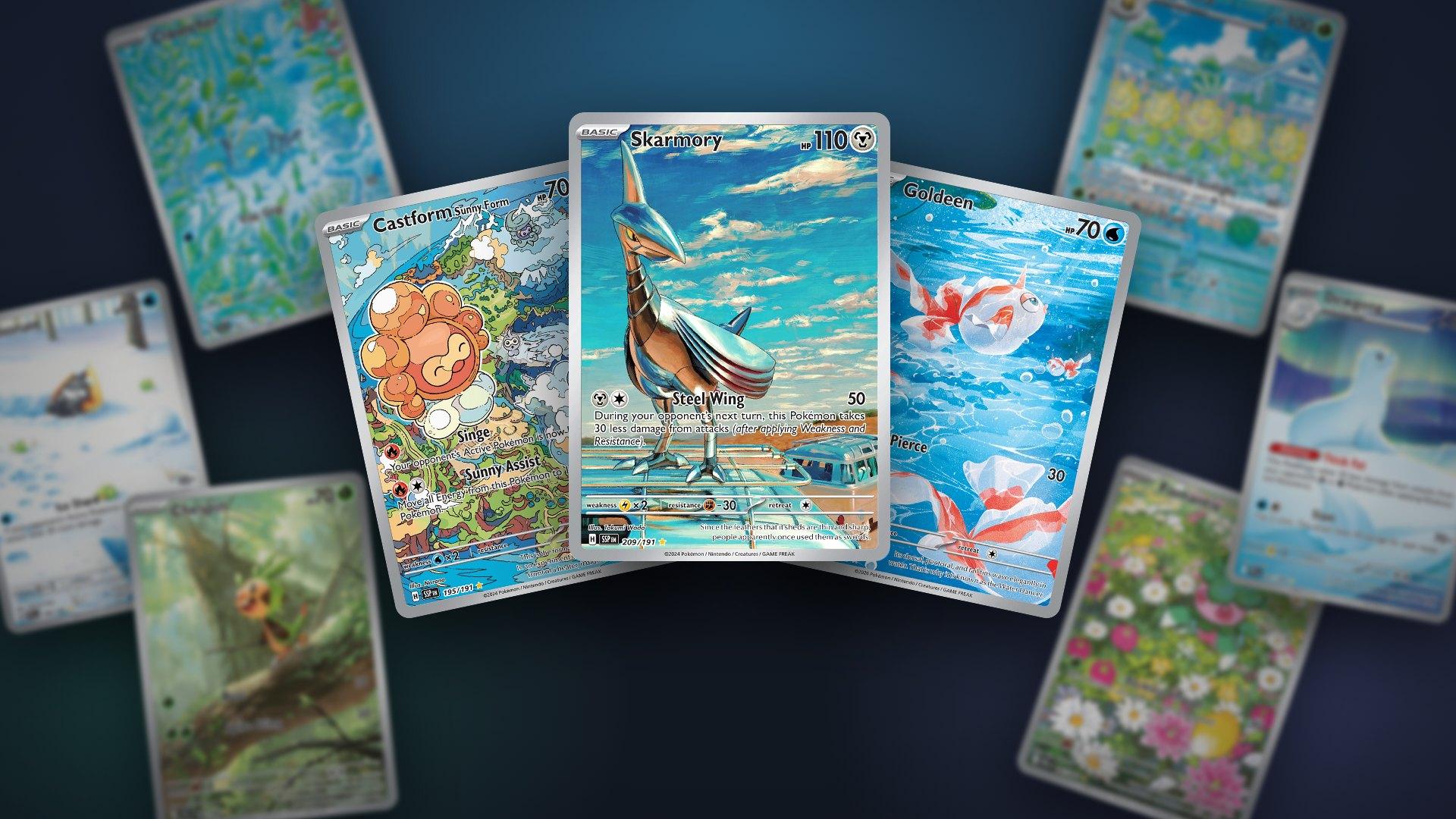
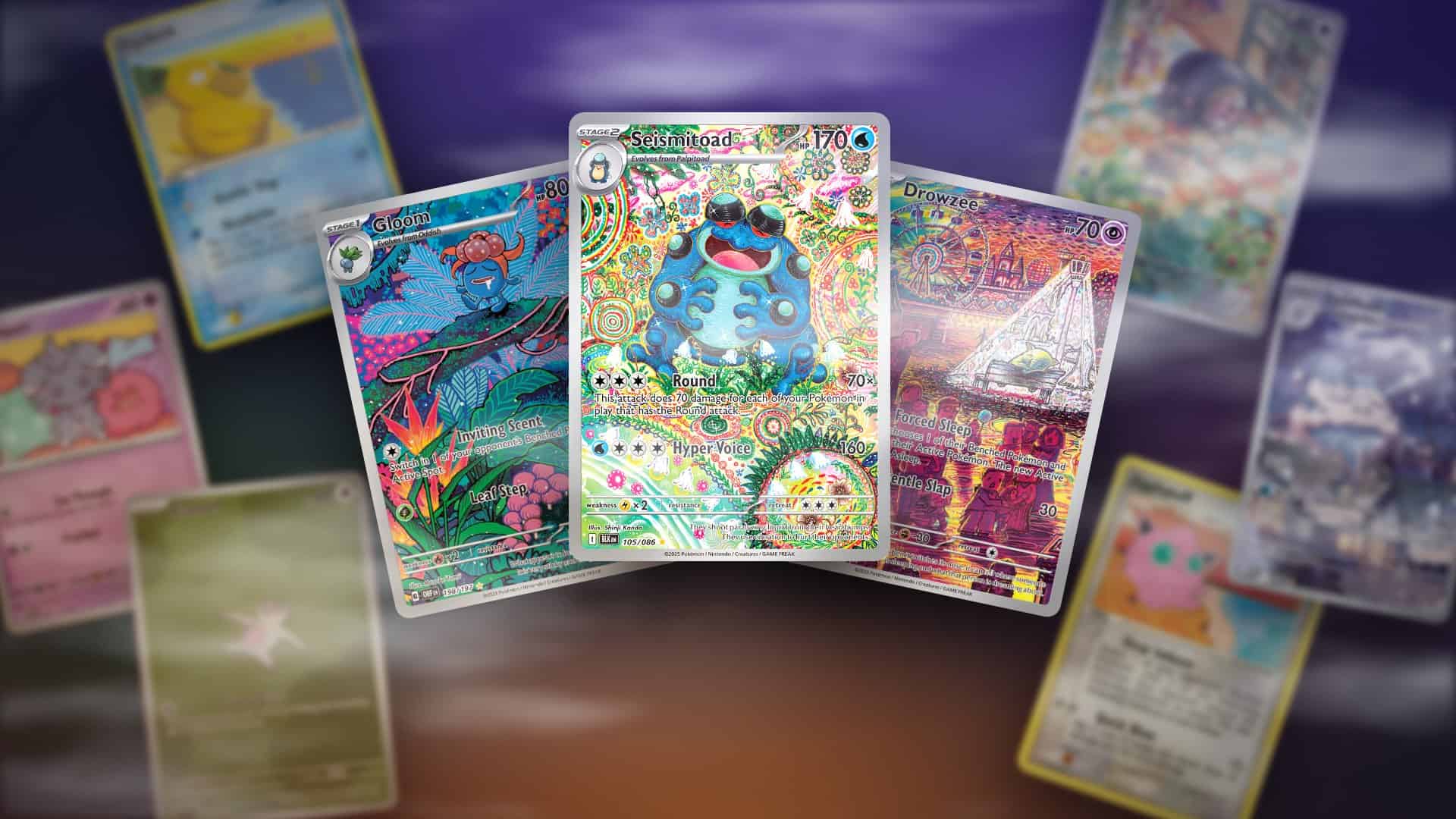
The standout mechanic was Tera Pokémon ex, whose crystalline design came with a crucial rule: they’re protected from attack damage while on the Bench, so your opponent can’t just snipe them before they’re ready. Later in the era, ACE SPEC cards made a comeback too. For collectors, Scarlet & Violet built the alt art idea into a proper rarity ladder with Illustration Rares (IR) and Special Illustration Rares (SIR), and those SIRs became the new chase cards for pretty much everyone. (For the full breakdown of the symbols, see our guide to Pokémon card rarities.)
This is also the era where the hobby went absolutely supernova. 151 sent nostalgic collectors back to the shelves, the Pokémon TCG Pocket app launched worldwide in October 2024 and brought a wave of brand-new fans with it, and then Prismatic Evolutions landed in January 2025 and emptied every Target, Walmart and Costco shelf in the country. We dug into why in why Pokémon cards are so popular now, and the frustrating side of it in can anything stop the Pokémon scalpers? The production numbers tell the story better than we can.

The era signed off in July 2025 with the twin sets Black Bolt and White Flare.
- English years: 2023 to 2025
- Releases tracked: 18
- Signature chase card: Umbreon ex 161/131
Mega Evolution Series
The Mega Evolution series is the current era of the Pokémon TCG. It kicked off with the Mega Evolution set on September 26, 2025, replacing Scarlet & Violet and bringing back a fan-favorite mechanic with a modern twist: Mega Evolution Pokémon ex. (We broke the news back when it was announced in Get Ready to Go Mega.)
Unlike the XY originals, these new Megas evolve straight from the normal pre-evolution (Mega Lucario ex comes from Riolu, for example) and, crucially, they do not end your turn. That one change turns Megas from awkward gimmicks into real centerpieces. The balance comes from the three-Prize cost when one gets Knocked Out, which makes every Mega a high-risk, high-reward play.
Collectors got new toys too. The first set introduced the gold Mega Hyper Rare, according to TCGplayer’s set breakdown, and Ultra Rare Item, Tool and Stadium cards picked up a striking new art style. If you love a bit of gold, our roundup of gold Pokémon cards is right up your street.
The Mega Evolution sets so far
A year in, this era is already stacked. Here’s how it’s unfolded in English:

| Set | English release | Why it matters |
|---|---|---|
| Mega Evolution | September 26, 2025 | Megas return, Mega Hyper Rares debut |
| Phantasmal Flames | November 14, 2025 | Mega Charizard X ex, and a launch we’d rather forget |
| Ascended Heroes | January 30, 2026 | Huge special set with a monster chase list |
| Perfect Order | March 27, 2026 | First of several smaller, near 1:1 copies of Japanese sets |
| Chaos Rising | May 22, 2026 | Mega Greninja ex |
| Pitch Black | July 17, 2026 | Mega Darkrai ex |
| 30th Celebration | September 16, 2026 | The 30th anniversary set, released worldwide on the same day |
| Delta Reign | November 6, 2026 | Mega Rayquaza ex and the new Legendary Stadiums |
Two of those deserve a closer look.
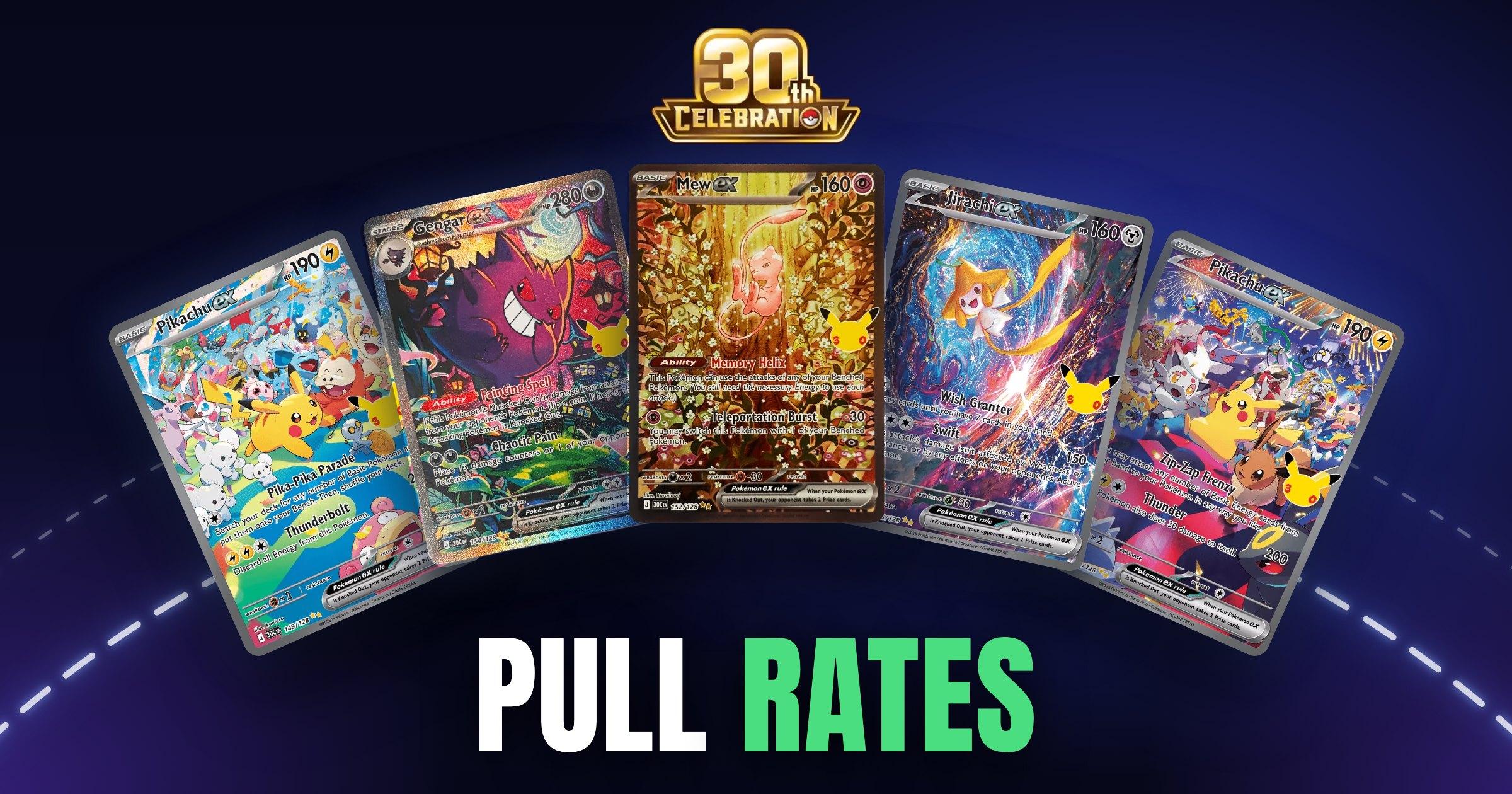
30th Celebration is the anniversary party the hobby had been waiting for. It was the first Pokémon TCG expansion to release simultaneously worldwide, every card in it is foil, and it debuted a brand-new Futuristic rare illustrated by YOSHIROTTEN. On top of that, every booster pack includes one of 30 Pikachu rares, and 30 classic cards return in the Classic Collection. Thirty years, thirty Pikachu. We see what you did there, TPCi.
Delta Reign lands on November 6, 2026, headlined by Mega Rayquaza ex. The part that made me grin is the new Legendary Stadium: two Stadium cards played as a pair to form one extended artwork. If that sounds familiar, it should. It’s the HeartGold & SoulSilver LEGEND idea, reborn fifteen years later. We covered the reveal in The Rumors Are True, and you can keep an eye on everything after it on our upcoming Pokémon card sets page.
As for chase cards, Megas rule the top of the price lists, but right now the most valuable English card of the era isn’t a Mega at all. It’s a Pikachu from Ascended Heroes. (If you’re chasing it, our Ascended Heroes pull rates guide will tell you what you’re up against.)
- English years: 2025 to now
- Releases tracked: 10 so far, with Delta Reign next
- Signature chase card: Pikachu ex 276/217
The odd ones out
Not every release fits neatly inside an era, and some of the best stories live in the gaps. Legendary Collection (2002) reprinted Base-era favorites and gave English collectors their first reverse holos, the famous “firework” pattern. If you’ve ever wondered where that finish came from, our holo vs reverse holo guide has the full story. Southern Islands was a strange, beautiful little set of panoramic art cards. And the POP Series and McDonald’s promos have quietly run alongside the main eras for years, sneaking some very collectible cards into tournament prize packs and Happy Meals.
Japan counts its eras differently
Everything above follows the English releases, but Japan got there first. Pokémon cards launched there in 1996 with the original Expansion Pack, and Japanese collectors use their own era names, such as ADV and PCG for the years that English speakers call the EX era. Japanese sets are also often split or combined differently before they reach us, which is why Delta Reign is based on Japan’s Storm Emeralda. If you collect both languages, the Japanese series pages on Card Codex follow Japan’s own groupings.
Pokémon TCG eras: quick answers
What era is the Pokémon TCG in right now?
The Mega Evolution era, which began with the Mega Evolution set on September 26, 2025. It’s still going, with Delta Reign next up in November 2026.
How many Pokémon TCG eras are there?
By the way most collectors group the English sets, fourteen: Base, Gym, Neo, e-Card, EX, Diamond & Pearl, Platinum, HeartGold & SoulSilver, Black & White, XY, Sun & Moon, Sword & Shield, Scarlet & Violet and Mega Evolution. Some people lump the first four together as the “WotC era”, which is fair enough, since Wizards of the Coast produced them all.
What was the first English Pokémon TCG set?
Base Set, released in 1999. It’s still the set that defines “vintage” for most collectors.
Which era should I collect?
Honestly? The one that makes you smile when you open the binder. If you grew up in 1999, that’s probably Base. If Umbreon alt arts live rent-free in your head, it’s Sword & Shield. Whatever you pick, track your collection on Card Codex so you can watch every era’s cards (and prices) in one place.