
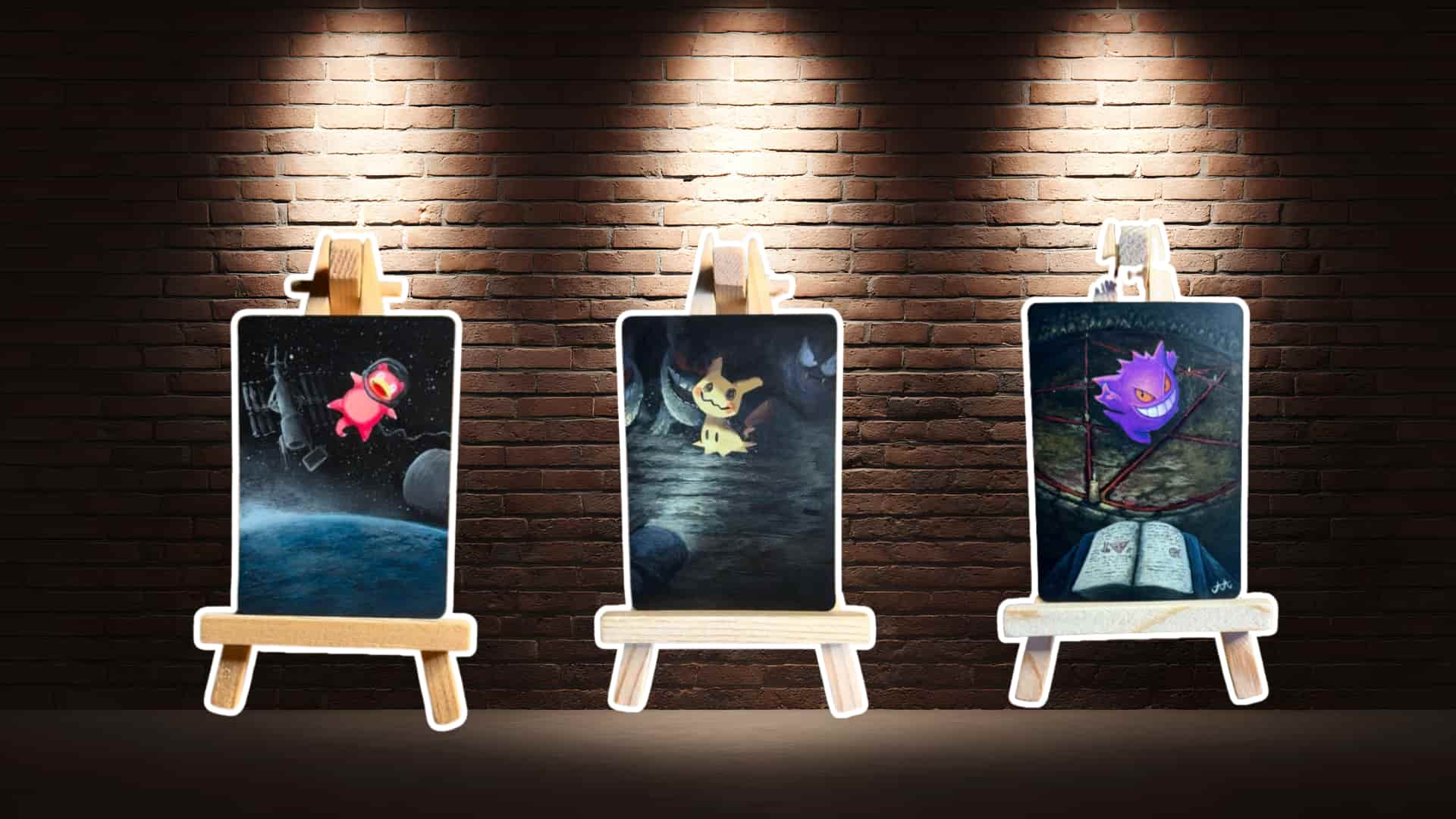
We often talk about grading cards, but what about reimagining them? This week, we sat down with Andrea (AndreArtworks), an Italian artist who turns standard Pokémon cards into hand-painted masterpieces. We discuss his unique style, the beauty of imperfection, and why some cards are just begging to be painted.
1) You specialize in “Alternative Pokémon Cards.” How did you first get started with alters, and was there a specific artist or card that inspired you to pick up the brush?
I honestly started almost as a playful experiment. I’ve always had a strong passion for painting and drawing, and I’ve always loved full-art cards. One day I simply decided to combine those two worlds, try to create my own full-art versions, and open an Instagram page to share them.
Many artists have influenced me over the years, not only from the Pokémon world but also from other TCGs, such as Magic: The Gathering. If I had to name two within the Pokémon world, Hironobu Yoshida and Ken Sugimori are definitely the artists who had the strongest impact on my artistic path.
Track Your TCG Collection
Create your free Card Codex account to monitor card prices, view real-time market trends, and analyse your portfolio’s growth.
Start Tracking Now — It’s Free2) Your bio states: “Hand-painted. Imperfections included.” In a hobby often obsessed with “Gem Mint 10” perfection, how does embracing imperfection shape your artistic philosophy?
I really like how this question places perfection and obsession side by side, because the pursuit of perfection can easily turn into an obsession that slowly strips away our true essence. For me, the true essence of art lives in imperfection—not as a flaw, but as the small details, gestures, or deviations from the standard that move away from what is considered “perfect” and instead reveal everything about the artist behind the work.
Being imperfect simply means being yourself, and I believe that should be the main goal of any artist, because it’s the only way genuine expression can exist. That sentence in my bio has been there since the very first day I opened my page. It’s a reminder to anyone who finds my work: this is not a space where perfection is chased. It’s a place where new stories are written, and where I try to bring something new, meaningful, and expressive to life.
3) Working on a standard card means your canvas is incredibly small. What is the biggest technical challenge of painting on this scale, or matching the original factory colors?
Size is definitely the first challenge when painting on collectible cards, but the material itself is equally challenging to work with. One of the most common questions I get is: “How do you make the paint stay on the card? When I try, it just slides away.”
Focusing specifically on scale, the biggest challenge is representing small, complex objects in a way that remains immediately readable to the viewer. No matter how meticulous you are, there’s a limit to how much detail you can realistically achieve, even with the finest brushes available. Because of that, I often rely on what I call visual shortcuts: shaping the entire scene so the object becomes recognizable through its context rather than through detail alone. A small book, for example, might be hard to identify on its own at that scale, but if it’s placed next to two other books arranged deliberately, it becomes instantly recognizable.
4) Your artwork mostly features dark, atmospheric environments. What draws you to this moody aesthetic over the bright, standard Pokémon style?
Interestingly, my very first altered cards were closer to the standard Pokémon style. While working on them, I started to feel disconnected from my true artistic identity, and that’s when I decided to change direction. I’m a big fan of dark fantasy, and I love working in low-key lighting, emphasizing strong contrasts and highlights against the dark. To me, this kind of atmosphere carries a powerful sense of energy and attraction.
Since my goal is to take an existing Pokémon and place it into an entirely new world, shifting the aesthetic helps reinforce that transformation and makes the scene feel more immersive.
5) How do you decide which cards to paint? Do you look for specific backgrounds that feel “unfinished,” or do you just paint your favorite Pokémon regardless of the original art?
Most of the time, people request a specific card through commissions. When the choice is mine, I usually start by looking at all the existing cards of that Pokémon and try to imagine a completely different world around it. My approach is very intuitive. I mentally strip away everything surrounding the Pokémon on the original card and focus only on its presence, then I start imagining a new environment.
Since I tend not to extend the original background but to replace it entirely, I’m not really looking for backgrounds that feel “unfinished.” What matters most to me is the Pokémon’s pose, size, and position within the card, because these elements determine how naturally the new scene will come together.
6) For collectors looking to buy their first hand-painted card, what is the best way to store or display these pieces to ensure the paint remains safe?
When it comes to acrylic paint, which I use, the main precaution is to keep the card away from water and excessive humidity, and this is good advice not just for altered cards, but for standard ones too. It’s also important to handle the card with care, watching for scratches or impacts that could damage the paint.
The most delicate areas to protect are the edges and corners, so I always recommend keeping the cards sleeved and using a toploader if you want some extra protection. Beyond that, cards can be safely stored in a binder without any issues.
7) If The Pokémon Company gave you full creative freedom to illustrate one official card, which Pokémon would you choose and where would they be?
I have so many ideas, but if I had to pick just one Pokémon, it would definitely be Gengar, my all-time favorite. For the setting, I’d naturally lean toward my preferred genre, imagining him at the entrance of a towering gothic cathedral, surrounded by a dark and atmospheric mood.
Though I’d be quite torn, because one of the environments I enjoy painting the most is the deep sea. A Magikarp or a Gyarados moving through the ruins of a lost Atlantis at the bottom of the ocean would be equally tempting.
8) Finally, where can people follow and commission custom cards from you?
You can find me on both Instagram and YouTube under the handle @andreartworks. If you’re interested in a commission, or even just want to chat, feel free to reach out via Instagram DMs.