


In a hobby that never sleeps, keeping up with the Pokémon TCG market can feel like a full-time job. Between sudden buyouts, overnight price spikes, and an endless stream of new sets, how do you stay informed without getting burned out?
Enter the Lucky Egg Report. A weekly report that has taken the Pokémon TCG subreddits by storm over the past few months!
We sat down with Lucario2ki, the creator of this essential weekly digest, to discuss the philosophy behind “leveling up” your collecting game without living on eBay. From his process for identifying undervalued “sleeper” picks to the rise of “species collecting” and the importance of watching the Japanese market, this interview is packed with actionable insights.
Read on to discover how he tracks the data, his predictions for the upcoming 30th Anniversary, and why he’d take a time machine back to 2016 for those Mario Pikachu boxes.
1. In the games, a Lucky Egg helps you level up faster. Is that the philosophy behind the newsletter? What made you decide to start condensing this sometimes wild hobby that is Pokémon TCG news into a weekly digest?
The name is definitely a nod to the games! The idea is that you should be able to “hold” the newsletter once a week and come away a bit more leveled up as a collector, without living on eBay, TCGplayer, etc. every day. To be honest, my original aim was just to have a nice, memorable name that was subtly related to what is being covered, and it just happened to fit really well with the mission of the newsletter.
There were a couple of factors that contributed to the start of it all. First off, and maybe most importantly, I’m a huge Pokémon fan and collector myself. Like most collectors nowadays, I grew up with it and collected anything and everything related to Pokémon, from cards of course, to bed sheets and even umbrellas. On the card side of things, my collection is mostly graded cards and tons of binders of raw cards filled with personal favorites.
When I started collecting more cards, I was already doing a messy version of the Lucky Egg Report for myself with an eBay watchlist of thousands of items, tabs open, random notes about sales, screenshots of weird auctions, and constantly finding myself asking what I’d missed that week, if anything.
At some point it clicked that the hobby might benefit from, or at least enjoy, a calm, organized digest that offers a bit of everything in an easy-to-read TLDR style. I come from a tech industry background, which can be just as hectic, and from personal experience I really enjoy reading newsletters and digests that can pull information from multiple places into a short, easy-to-read format.
Track Your TCG Collection
Create your free Card Codex account to monitor card prices, view real-time market trends, and analyse your portfolio’s growth.
Start Tracking Now — It’s Free2. We love your “Potential Sleepers” section (that Poliwhirl from 151 is a beauty!). What is your process for identifying a sleeper? Are you looking at population reports, artwork vibes, or just gut feeling?
Your question kind of contains the answer in that it’s a mix of a bit of everything. It usually starts with, “Why is this so cheap?” The way I find the cards is either through ones I already have personal experience with, something I see come up for auction, or a card that keeps popping up in conversations but still isn’t expensive.
From there I look at a few things in combination: pop reports and how quickly populations are growing, the era and print realities (vintage vs modern, low print run vs printed to the moon), how the card fits into the set, and of course the art. Some cards are just really appealing to the eye. I also compare raw prices versus graded prices. Not everyone wants to shell out hundreds for a PSA graded copy (typically a 10), and sometimes I just want something for the binder even if it’s not in perfect condition.
There is definitely some gut feeling and “vibe check” involved, but I try to keep it as informed as possible. And for transparency (which you can see from past reports), many of my sleeper picks have dropped in price. But in my book that’s not a bad thing. There’s something to be said for picking up a nice card that hasn’t blown up in price and balancing “this might do well” with “I just genuinely like this.”
3. Looking at the recent hype around “Kabuto King” – Do you think the hobby is shifting more towards “Species Collecting” (collecting one Pokémon) rather than chasing the expensive “Meta” cards?
I think species collecting has been around and growing for years, and we’re just seeing it more clearly now because social media amplifies it. When something like “Kabuto King” takes off, it’s often carried by how surprising the narrative is and how viral it can become. Kabuto isn’t necessarily a card most collectors would think to focus on compared to a more popular Pokémon like Charizard or Pikachu, so when people see that story, they naturally can’t help but want to see where it goes next.
That said, I see species collecting as something that runs in parallel to collecting meta or high-end chase cards rather than replacing it. It’s like an extra lane that keeps getting busier. The big competitive or staple cards will always matter, but species collecting lets people participate in a way that feels more personal and less tied to formats or rotations, which is really important for growing the community as a whole. You can be “the Kabuto person” or “the Piplup person” and build a whole identity around that, even on a modest budget. I have multiple favorites, but lately I’m a Ludicolo person.
4. You track sales and check prices on a weekly basis, but is there a card in your personal collection that is effectively “priceless”? The one you’d never trade?
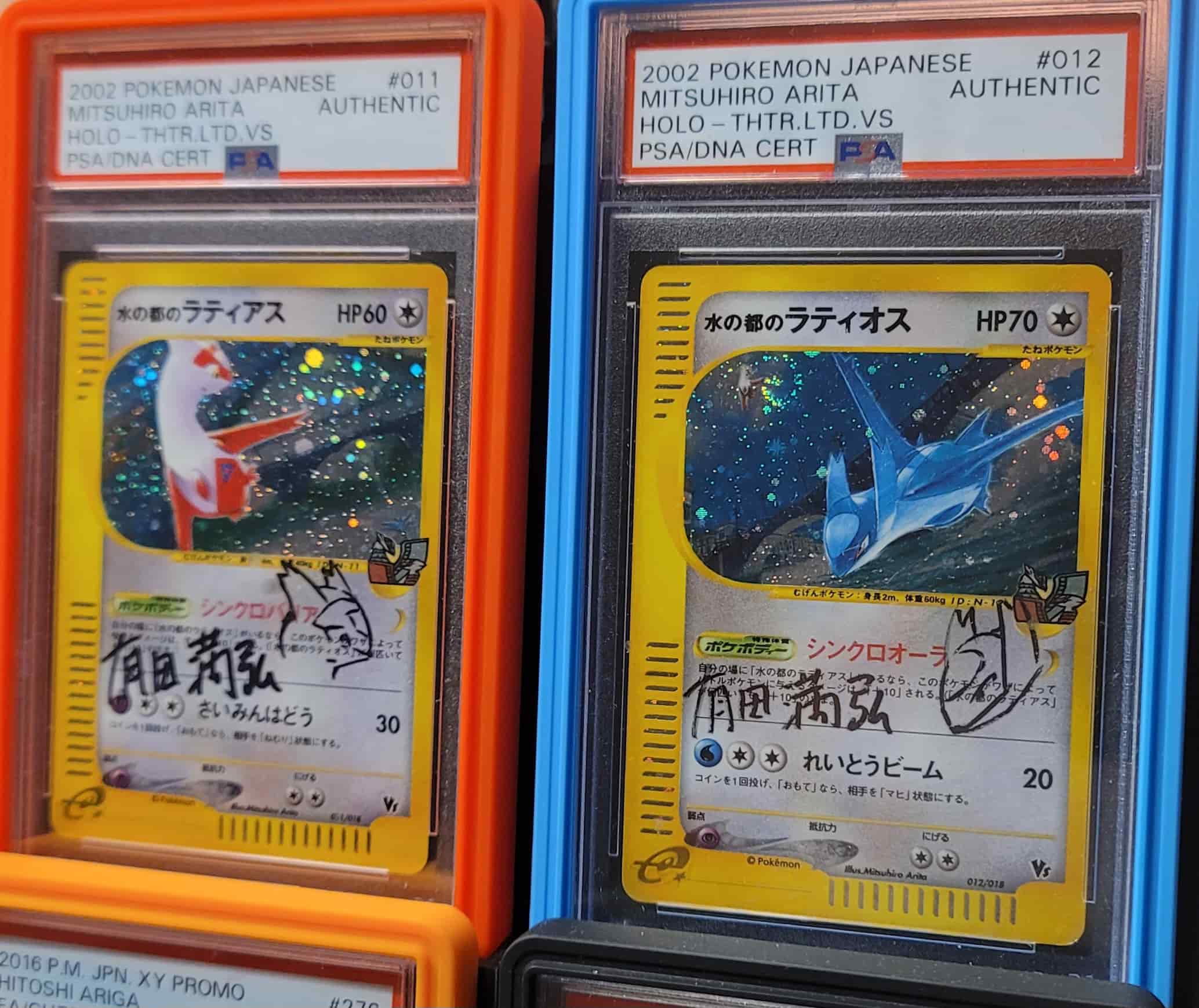
Definitely! It has to be this Mitsuhiro Arita–signed pair of Alto Mare Latias & Latios promos from the 5th movie, Guardian of the Water City: Latias and Latios. I love Latias and Latios, and these two promo cards are my absolute favorites. The hand-drawn signature art by Arita who of course is prolific in Pokémon in his own right, pairs so well with the cards themselves that I could never give them up.
5. Is there a set or a Pokémon that the market hates, but you secretly love? (We won’t judge… much).
I can definitely think of a few. Off the top of my head, I think the Pokémon GO set fits that bill. It’s not that it’s hated, but even the most popular cards from the set haven’t really taken off yet in popularity compared to other releases from around the same time, like Astral Radiance and Lost Origin.
This is definitely where my “vibe check” takes over, but I have a feeling that as more time passes, those cards will start to surface more and more, because some of the art and theming is really underrated. In particular, Dragonite V #49, Mewtwo V #72, and Radiant Charizard #11, Blastoise #18, and Venusaur #4 all come to mind.
6. You cover a lot of Japanese news (like the Start Deck 100 reveals). For collectors who strictly stick to English cards, how important is it to watch the Japanese market? Do you view it as a crystal ball for what’s coming to the West, or is it becoming a totally separate beast?
If you only collect English, you don’t need to obsess over every Japanese release, but ignoring it completely means leaving useful information on the table. Japan still gets many cards first, along with some incredible Japanese-exclusive promos. In general, you can often see which arts or mechanics (if you play the TCG) are resonating there before they hit English shelves, and that can be a really helpful context when you’re deciding what to prioritize.
That being said, I do view Japanese data as a kind of crystal ball for the West and the wider international market. It gives you a sense of what might be coming, but local conditions still matter once it finally arrives in English. That’s not to say the Western market isn’t independent, though. The Celebrations set, for example, gave us amazing cards that were never released in Japanese, like the Gold Metal Pikachu and Charizard, or modern Pokémon reimagined in vintage styles like Light Toxtricity.
7. The Pokémon market doesn’t sleep. Has there ever been a piece of breaking news (like a sudden buyout or a leaks drop) that happened right before you hit “Send” on the newsletter that made you scramble to rewrite everything?
Honestly, it happens all the time. I figure that’s just the nature of a market that, like you said, never sleeps, and it’s impossible to capture everything. Luckily it’s rarely to the extent where I need to rewrite the entire report, but there are definitely times when a huge lot of incredibly rare vintage items sell and I find myself wishing I’d waited a bit and saved some space in the newsletter for it.
At the end of the day, one of the main goals is to deliver news that’s insightful but also just plain interesting, the kind of thing that occasionally makes you say “wow!”. To give one concrete example, just as I had wrapped up the report and created the visual slides and everything, I saw that a BGS 10 Black Label copy of the famous Luigi Pikachu sold for $216k (including a 20% buyer’s premium from the auction house). That was definitely one I wish I’d known about a little sooner.
8. If you could go back to 1999 with $100 in your pocket, we know you’d buy Base Set. But if you could go back to 2019 (just before the boom) with $500, what are you buying?
I love this question because of all the possibilities and all the heartache that comes with the missed opportunities. Personally, I would go all in on Japanese-exclusive promos and sets, which are my favorites both for collecting sealed, complete products to admire and for the individual cards themselves. There are way too many to choose from, but off the top of my head it would be the Mario & Luigi Pikachu boxes and the other Pikachu Poncho boxes.
It’s wild to think that when most of these boxes were released in 2016, they retailed for about $40–$50, and now they sell for thousands. Aside from those, I’d also grab tons of fresh, unpeeled sheets from the Japanese Vending Series, which introduced the amazing Masaki Promos (although these were not directly on the sheet themselves) and Ooyama’s Pikachu, all with that quirky, charming artwork.
9. Without giving away all your trade secrets, how do you actually track all this data? Is it an army of spreadsheets that would make a sleek Porygon jealous, or do you have some custom tools helping you scrape the sales data?
In the beginning, there was definitely a lot of manual work involved! Over time I’ve built a hybrid system: some manual tracking, some automation via scripting to generate my own daily digest of sales that I can filter through for the report, and a lot of structure around how I log interesting sales or trends.
I still spend a fair amount of time actually looking at listings by hand, because context matters. A headline price without photos, condition notes, or an understanding of the seller can be misleading. Tools and scripts help catch patterns and save time, but the final pass is still very human. I definitely won’t object to more automation in the future where it makes sense, but not at the cost of quality. That’s not to say I don’t make my fair share of typos or mistakes in plenty of reports anyway – I promise I’m working on this!
10. Running a newsletter is a grind—you have to show up every single week. Have you ever had a week where you just thought, “Man, I really don’t want to look at another eBay sold listing today,” and how do you push through that burnout?
I can’t deny that I’ve felt that way before, but as weird or obvious as it may sound, I actually really like putting all this information together every week, and I think that’s just enough to help me power through even when things are really busy. I’ll often try to step out of my own shoes and read the report from a third-party perspective and think to myself, “Wow, this is actually pretty interesting.” Now, whether that’s the most egotistical statement ever or actually genuine is up to the readers to decide.
What also helps is remembering why I started: to make sense of the hobby for myself and to share that with people who genuinely care. I try to protect the process a bit by batching certain tasks, keeping templates, leveraging the tools I’ve built, and working on it a little each day so that by Sunday I can do some checks and feel good about it.
11. You cover Pokémon TCG beautifully. Do you ever get tempted to dip your toes into One Piece, Lorcana, or Magic: The Gathering, or do you believe in staying hyper-focused on one lane to serve that specific audience better?
Thanks so much for the kind words I will always aim to improve and take any feedback to do so. I’m a huge One Piece fan, and a fan of other TCGs as well, even though I don’t have as much experience with them. I see so much cool art coming out of the One Piece TCG, and I feel like the format of the Lucky Egg Report is something that would work really well for other games, too. From a pure curiosity standpoint, it’s very tempting to dive in, and I definitely plan to at some point.
That said, staying focused on Pokémon for now has been intentional. The hobby is already complex enough that doing it well takes a fair bit of bandwidth. I’d rather serve one audience deeply and consistently than skim across even one more TCG and risk compromising on quality for both. Even so, I do feel like I’m reaching a point of efficiency where it might become possible with a bit more planning. Stay tuned, because something might pop up sooner than later!
12. We’ve got the 30th Anniversary looming on the horizon. Do you have any big special projects or deep-dive reports planned to celebrate the big 3-0, or are you just bracing for impact like the rest of us?
A little of both! The 30th is going to be noisy no matter what, so part of the job will be cutting through the chaos and highlighting the interesting stuff. I also have to admit up front that it won’t be perfect, even though I’m really looking forward to it.
Since the general format of the report is TLDR-style, at a minimum I’d love to do a more specialized “cards over the past 30 years” retrospective and see if I can strike a balance between something that’s easy to read and something that still feels like a proper deep dive.
13. Lastly, where can people follow your journey, and what is in store for you next year?
The main place to follow along is the newsletter itself, where the “full” content lives with links to interesting auction sales and everything else. I also post a more condensed, visually-focused set of slides on most social media platforms (alongside the email) every Monday, so I like to think there’s something for everyone.
In general, you can follow and reach out to me anytime on Reddit at the username u/lucario2ki, where a lot of good discussion happens on the report posts, and on other platforms like X, Instagram, and TikTok at the handle @luckyeggreport, where I’m still learning how to grow and market myself a bit better. You can also visit news.luckyeggreport.com for all of this information in one place.
As for next year, the big focus is quality content and growth. The support and feedback so far have been amazing, but there’s still more work to do. The plan is simple: keep showing up, keep improving the quality, and keep it fun enough that people actually look forward to Monday. Hopefully, with consistency and quality comes growth, and with that will come more fun collaborations and special projects, just like this one with Card Codex. It was so much fun answering these questions, and thanks so much for having me!