
Ever get that sinking feeling? You’ve just snagged what you think is a killer deal on a rare card, but something feels… off. In the world of Pokémon TCG, where a piece of cardboard can be worth its weight in gold, fakes are an unfortunate part of the landscape. They’re the Team Rocket of the collecting world, trying to snatch your joy (and your money).
And here is the part that made me rewrite this whole guide: it is getting worse, fast. PSA’s 2025 Fraud Report found that counterfeit Pokémon submissions jumped 125% in a single year, and that the company intercepted more than $200 million in projected market value of fraudulent collectibles. PSA’s own president called that number conservative and suggested the real figure could be north of a billion dollars.
That is just what walked through one company’s front door.
But don’t worry, you don’t need to be a Pokémon Professor to outsmart them. This guide is your personal Pokédex for spotting fakes, turning you from a nervous newbie into a confident authenticator. We’ll cover everything from quick physical checks to the nitty-gritty details that give a counterfeit away, plus the newer stuff: fake slabs, resealed boxes, and why some of the old advice you’ve read on forums will now flag a perfectly real 2026 card as a fake.
At-a-Glance Counterfeit Checklist
In a hurry? Think of this as your Quick Attack. This checklist covers the most common red flags. If a card fails one or more of these checks, it’s time to use a more powerful move and dig into the detailed analysis below.
| Attribute | Authentic Card Characteristics | Common Counterfeit Characteristics |
|---|---|---|
| Card Stock/Feel | Sturdy, premium matte finish; rigid but with slight flex. | Flimsy, papery, or overly glossy/plasticy; too flexible or too stiff. |
| Dimensions/Cut | 2.5 x 3.5 inches (63mm x 88mm); smooth, evenly rounded corners. | Incorrect size (too large or small); jagged edges, inconsistent corners. |
| Edge Layers | A visible, thin black or dark gray line between two white layers on the edge. | A single, solid layer of white or off-white cardboard; no black line visible. |
| Back Color/Detail | Rich, multi-toned blue with detailed swirls; crisp border. | Washed-out, purplish, or single-toned blue; blurry, indistinct details and border. |
| Font/Text | Crisp, specific proprietary font; consistent letter spacing (kerning). | Incorrect, blurry, or “close-enough” font; awkward, large gaps between letters. |
| Energy Symbols | Correctly sized, centered, and well-defined within their orbs. | Bloated, misshapen, off-center, or too large for the orb. |
| Holofoil Pattern | Dynamic, layered pattern that shifts with light; correct pattern for that specific set and era. | Static, flat sheen; vertical “cheap” shine; incorrect pattern or printed-on holo effect. |
| Texture | Distinct, fingerprint-like texture on applicable cards (ex, Illustration Rare, Full Art, older V and VMAX). | Smooth, glossy surface on cards that should be textured, or a texture that doesn’t follow the artwork. |
| Graded Slab | Cert number resolves in the grader’s public database and matches the card in the case. | Cert doesn’t exist, resolves to a different card, or the holder shows re-seal seams. |
Any single failure is a reason to slow down, not a verdict. Two or more failures and you should walk away.

Track Your TCG Collection
Create your free Card Codex account to monitor card prices, view real-time market trends, and analyse your portfolio’s growth.
Start Tracking Now — It’s FreeThe Touch and Feel Test
Before you even look closely, your hands can tell you a lot. These first checks are your first line of defense and can often expose a fake in seconds.
The Card Stock Test
Your hands can be your best sidekick in this quest. Think of it like knowing the difference between a real Poké Ball and a painted rock. The Pokémon Company uses a special, high-quality card stock that feels just right, sturdy, premium, with a satisfying matte finish. It has a bit of flex, but it’s not a pushover.
Counterfeits often feel… well, cheap. They might be flimsy and papery, bending like a sad Magikarp, or they could be weirdly stiff and thick, like a piece of cardboard from a shipping box. Another dead giveaway is the surface. Real cards are smooth but not slippery. Fakes often have a greasy, plasticy gloss, a lazy attempt to look fancy that just ends up feeling wrong.
After handling a few real cards, your hands will develop a kind of muscle memory. Any card that doesn’t feel right will set off your internal alarm bells. A card that doesn’t feel right and a card that is simply beaten up are two completely different problems, and your hands will learn to tell them apart faster than your eyes will.
Does It Measure Up? Size and Cut Matter
Think of The Pokémon Company as a master chef who cuts every single ingredient to the exact same size. Every. Single. Time. An authentic Pokémon card is precisely 2.5 by 3.5 inches (63mm x 88mm). No exceptions, unless you are holding an oversized promo, in which case you should read up on the jumbo card format before you panic.
Fakes, on the other hand, are often cut with less care, so they might be a little too big or a little too small. The difference can be subtle, but when you put it next to a real card, it sticks out like a Snorlax in a flower bed. Pay attention to the edges, too. A real card has smooth, clean edges and perfectly rounded corners, like they were cut with a laser.
Fakes often have rough, fuzzy edges with little bits of cardboard fluff, and the corners can be all over the place, some too round, some too pointy. It’s the kind of sloppy work Team Rocket would be proud of.
Like an Onix, Cards Have Layers
Here’s a pro tip that counterfeiters hate. Real Pokémon cards are like a delicious sandwich (or maybe a less-delicious Oreo). They’re made of three layers: two white outer layers with a thin black layer squished in the middle.
You don’t need X-ray vision to see it, just look closely at the edge of the card. You should see a faint but distinct black line running right through the center. Fakes are almost always made from a single, cheap piece of cardboard, so that black line will be missing.
This is why you should never, ever do the “rip test.” Tearing a card is a one-way trip to Pallet Town for that card, and you can get the same information just by looking at the edge. That black layer isn’t just for show; it’s a clever security feature to keep the card from being see-through. Remember that for later when we talk about the light test.
A Closer Look
Once you’ve done the initial feel test, it’s time to put on your detective hat and examine the visual details. This is where most fakes fall apart under scrutiny.
The Card Back Check
The back of a Pokémon card is your secret weapon. Why? Because for nearly every English card since 1999, it’s been exactly the same. It’s your constant, your North Star, your… well, you get it. Counterfeiters often pour all their energy into the flashy front, hoping you won’t flip the card over. Big mistake.
The blue on a fake is often just… wrong. It might be a washed-out, pale blue, or even have a weird purplish tint. A real card back has a rich, multi-toned blue swirl, like a beautiful ocean. Fakes often look like a flat, boring puddle. Also, check the details. The border should be crisp, and there’s a specific mottled texture in the light blue swoosh next to the Poké Ball.
On fakes, this is often just a blurry blob. If you’re buying online and the seller “forgets” to show the back? That’s not just a red flag; it’s a whole parade of them.
Front-Facing Flaws
Okay, let’s flip it over. The front of a card is a minefield of potential errors for a lazy forger.
- Funky Fonts: The Pokémon Company uses its own special font. Fakers have to guess, and they often guess wrong. The letters might be too thick, too thin, or just shaped weirdly. An even bigger giveaway is the spacing (the “kerning”). Fakes often have awkward, clumsy gaps between letters that just look unnatural.
- The Missing Accent: This is a classic blunder. The “é” in “Pokémon” has an accent. If it’s missing anywhere on the card, name, attack text, copyright, you’ve caught a fake. It’s like spelling Ash “Ashe.” Just wrong.
- Spelling Bee Fails: You’d be amazed. Fakes are often riddled with typos and bad grammar. If your “Pikachu” is spelled “Pikacho,” it’s time to say goodbye.
- Wonky Energy Symbols: These little symbols are a counterfeiter’s nightmare. On fakes, they’re often bloated, misshapen, or not centered in their little circle. The star in the Colorless energy symbol is a great one to check; on fakes, its points often poke out of the circle. If you’re fuzzy on which symbol is which, our guide to what every symbol on a Pokémon card means is the cheat sheet you want open in another tab.
- Impossible Stats: This is where fakers show they don’t actually play the game. An attack that does 9000 damage? That’s not a rare card; that’s a fake card. Sometimes they’ll even mess up the evolution line, like saying a Pidgey evolves from a Snorlax. Always give the card a quick read; if it doesn’t make sense, it’s probably not real. A little knowledge of how to read a Pokémon card goes a long way.
One important recalibration on that last point, because this one has changed and I’ve seen people get it wrong. HP numbers have crept up a lot. Mega Pokémon ex in the current Mega Evolution era routinely carry HP totals that would have looked absurd five years ago. So a huge HP number on a modern card is not automatically a fake. A huge HP number on a card printed in 2003 absolutely is. Judge the stat against the card’s era, not against your memory of Base Set.
Art & Print Quality
Real Pokémon cards are printed using high-quality, super-sharp images. Fakes are usually made from a scan of a real card, and just like a photocopy of a photocopy, the quality drops fast. The result? The art and text on a fake will often look blurry, fuzzy, or even pixelated.
The colors are another big tell. Fakes can be washed-out and faded, or sometimes they’re way too dark and oversaturated. It’s like they turned the contrast dial up to 11. And sometimes, the art is just completely wrong, like, “Is that a Digimon?” wrong. When in doubt, pull up an image of the real card from an online database. Our set browser has every English and Japanese set in it, so you can find the genuine print in about ten seconds and compare side by side.
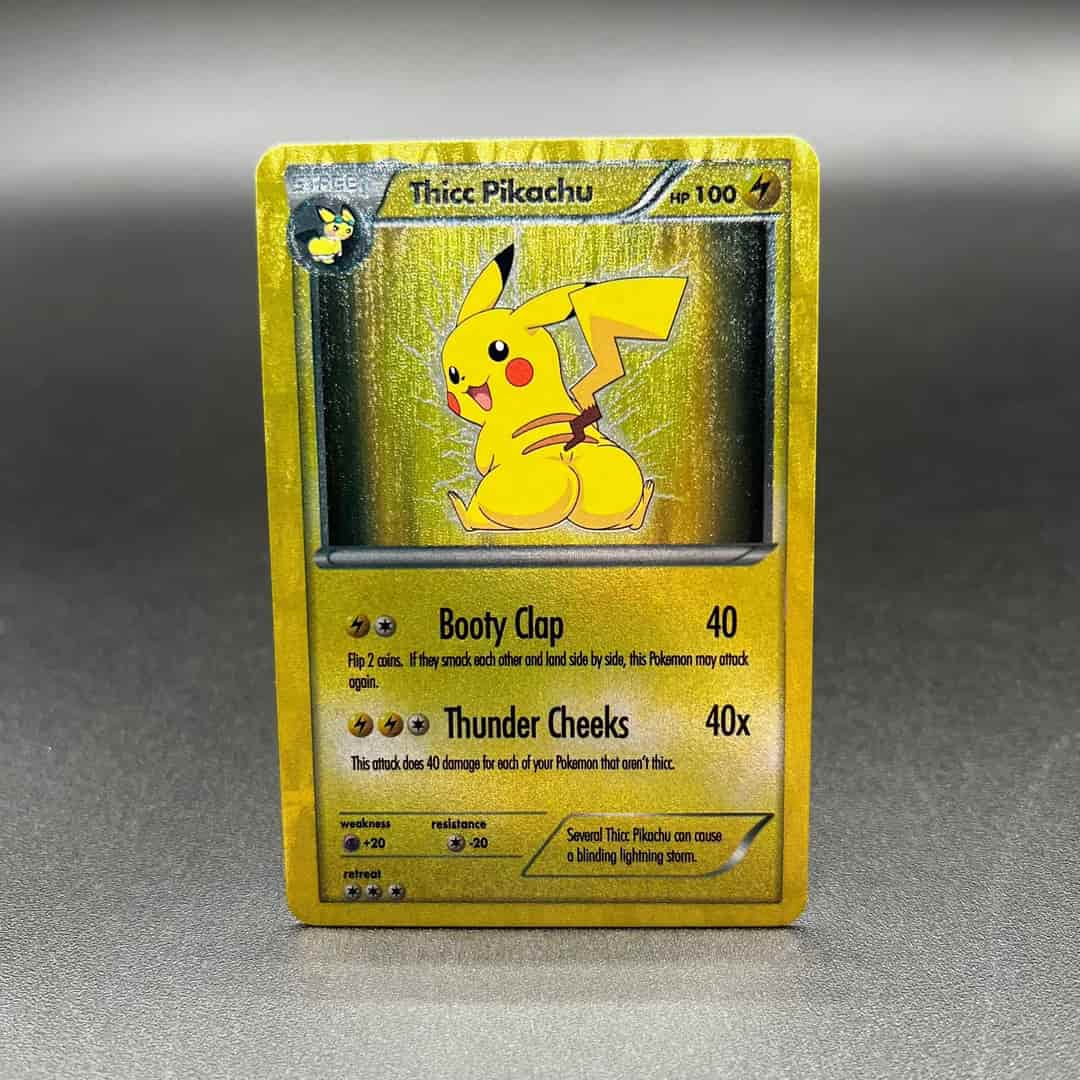
This also includes the infamous gold Pokémon cards you often see on sites like AliExpress; while they might look flashy, they’re a classic example of a novelty counterfeit with no official standing or value.
The Shiny Stuff: Holos and Textured Cards
The rarest and most desirable cards often have special features like holographic foil and textures. These are meant to be hard to copy, which makes them a great place to spot a fake.
The Holo Test
Ah, the holos. The cards that sparkle and shine. They’re beautiful, valuable, and a huge headache for counterfeiters. A real holo has a dynamic, layered pattern that seems to move and shift as you tilt it in the light. It has depth. Fakes often just have a flat, static shine.
A common fake has a cheap-looking vertical rainbow sheen that covers the whole card, borders and all, and that is a dead giveaway across most types of Pokémon card rarity. Some fakers get even lazier and just print a picture of a holo pattern onto a regular card. It looks shiny in a photo, but in your hand, it has no life at all.
Here’s a master-level tip: the holo pattern on real cards is never identical. They’re cut from huge sheets, so each card is unique. If a seller has a bunch of “rare” holos and the star pattern is in the exact same spot on every single one? You’ve just busted a whole batch of fakes.
The Reverse Holo Trap
This is the section I most needed to add, because the advice everyone repeats has quietly gone out of date.
For years, the rule of thumb was simple: a real reverse holo has a busy, patterned foil, and a flat smooth shine means fake. That rule was fine right up until the Mega Evolution era arrived. Cards from Mega Evolution Base onward dropped the shape-based reverse holo patterns entirely in favour of a smooth, light foiling with no pattern at all.
Read that again, because it matters. If you apply the old rule to a card pulled last week, you will convince yourself a genuine card is fake.
So the check is not “does it have a pattern.” The check is “does it have the right treatment for its era.” Sword & Shield reverse holos look nothing like Scarlet & Violet reverse holos, which look nothing like the current smooth foil. If you want the full tour of how these finishes evolved, our breakdown of holo versus reverse holo covers it, and the short history of each Pokémon TCG era will tell you which era your card actually belongs to.
Same warning applies going forward. The 30th Celebration set is bringing new finishes with it, and every time the printing changes, the folk wisdom needs a patch.
The Texture Test
More modern ultra-rare cards have another awesome security feature: texture. It often feels like a fingerprint or a pattern that follows the artwork. It’s cool, and it’s really hard to fake. The easiest test? Just run your finger over it. If a card that should feel like a relief map is as smooth as a Ditto, it’s a fake.
Do note that “which cards should be textured” is itself era-dependent. V and VMAX cards were textured, but those ended with Sword & Shield. Today you’re looking at ex, Illustration Rares, Special Illustration Rares and the newer Mega tiers, each with their own treatment. Our guide to the different types of Pokémon card is the fastest way to work out what you’re actually holding.
But be warned, some fakers are getting better and adding their own texture. So now, it’s not just about if there’s texture, but if it’s the right texture. Real embossing follows the contours of the art. Fake texture tends to be a generic repeating pattern slapped over the whole surface, ignoring what’s underneath. Run your finger diagonally across the art; if the ridges do not change where the artwork changes, be suspicious.
Advanced (and Risky) Tests
Some tests are popular but can be misleading or even destructive. Approach these with the caution of a trainer entering the Elite Four.
The Light Test, Properly Understood
The light test gets a lot of stick online, and I used to be more dismissive of it than I should have been. Worth knowing: The Pokémon Company itself recommends it, telling customers that counterfeits are often easy to see through when held up to a bright light. When the people who print the things say to do it, you do it.
The idea is you shine your phone’s flashlight through the card. Since real cards have that black middle layer, they block most of the light. Cheap single-layer fakes light up like a Christmas tree.
The nuance is what you do with the result. A card that blocks light is behaving normally. A card that glows through like tracing paper is almost certainly fake. But a card that lets a little light through is not automatically anything, because holo layers, era, and card stock all shift how much gets through. Vintage cards behave differently from modern ones.
So use it as a strong first filter, not a verdict. It catches the lazy fakes instantly, which is most of them. For the good fakes, you’re going to need the print quality and texture checks above.
The Rip Test: Please Don’t
And now, we come to the rip test. This involves… well, ripping a card in half. Yes, it will 100% tell you if there’s a black layer inside. But it will also 100% destroy the card. This is the nuclear option. It’s completely unnecessary when you can just look at the edge. Please, for the love of Arceus, don’t rip your cards unless you’re absolutely certain it’s a worthless fake and you’re doing it for science. Otherwise, just step away from the card.
It’s a Trap! Spotting Fake Sealed Products
The scam doesn’t stop with single cards. Fake booster packs and boxes are everywhere, waiting to ambush an unsuspecting buyer. And here’s the part that stings: eBay’s authentication programme, which we’ll get to shortly, explicitly excludes sets, lots, decks, boxes and packs. Sealed product is the one category where you are entirely on your own.
Spotting Fake Booster Packs
Fake booster packs can often be identified by flaws in the wrapper’s material, printing, and sealing.
- The Crimp: Look at the top and bottom of the pack. A real pack has a clean, flat crimp seal. Fakes often have a jagged, saw-toothed crimp that looks like it was sealed with a pair of angry scissors. The wrapper material itself might also feel cheap and thin.
- The Fit: A real pack is sealed nice and tight. If the wrapper is loose and baggy with the cards rattling around inside, be suspicious.
- Glue: Factory packs are heat sealed. They are not glued. If you can see adhesive residue along a seam, somebody has been inside that pack and put it back together.
- The Contents: If you do open a pack, the contents can be a dead giveaway. No code card? Cards facing the wrong way? An impossible number of ultra-rares? You’ve been had. It’s worth knowing what your code card is actually telling you, because a missing or mismatched one is one of the loudest signals there is.
Checking Booster Boxes
A sealed booster box is a big purchase, so you want to be sure. It’s all about the shrink-wrap.
- The Official Wrap: A real, factory-sealed box has a specific plastic wrap with repeating white Poké Ball logos on it. No logos? Plain shrink-wrap? It’s either a fake or it’s been resealed by a scammer.
- Seams and Holes: The seams on the wrap should be clean, not messy. They often form a neat “T-shape” where the plastic is gathered. Real wrap also has tiny, almost invisible air holes to let air escape during sealing.
- The Insides: If the box is open, check the packs. They should be neatly organized. If they’re all jumbled up like they’ve been through a hurricane, that’s a huge red flag.
There’s a second version of this scam that isn’t counterfeiting at all, and it might be more common. Somebody buys a genuine Evolving Skies Booster Box, opens it, searches the packs, pulls the chase cards, then reseals the whole thing and sells it as untouched. The box is real. The wrap is convincing. The lottery ticket you just bought has already been scratched.
Your defences here are weight (a searched box is often light by a few grams, so compare against a known-sealed one), wrap tension, and price. Nobody sells genuine sealed product below what it cost them. If a box from a hot set is 30% under market from a seller with no history, you are not lucky. You are the mark.
The Slab Problem: When the Case Is the Fake
Here’s the bit that would have felt paranoid a few years ago and now just feels like Tuesday.
In January 2026, a federal jury convicted a man of wire fraud for running a nationwide scheme selling sports and Pokémon cards in counterfeit PSA holders with forged grades. Prosecutors said the operation targeted victims across the country and attempted to defraud them of more than $2 million. He took real labels, stripped the grade and serial number, and printed elite grades back onto them.
So the card can be real. The plastic can look right. The label can be a lie.
The good news is that checking a slab is genuinely easy and takes about fifteen seconds:
- Look up the cert number in the grader’s public database before you pay. Every major grader has one. If the number doesn’t exist, or it resolves to a completely different card, you’re done.
- Compare the image in that database entry to the card in front of you. This is the step people skip, and it’s the one that catches label swaps.
- Inspect the case seams for re-seal marks, glue haze, or a slightly off-colour weld line. Cracking and re-sealing leaves traces.
- Check the label generation against the claimed submission date. Graders change label designs over time, and mismatches are a strong tell. Our piece on old certs versus new certs walks through what changed and when.
We have a whole guide dedicated to this, because it deserves one: how to identify fake PSA slabs. If you buy graded cards at all, read it. The grading industry is also building better defences, and some of the authentication technology now being deployed is genuinely impressive. It is also not in your hands at the point of purchase, which is why the cert lookup still matters.
Which Cards Are Actually Getting Faked
Counterfeiters are not romantics. They fake what sells.
PSA’s data puts Charizard at the top of the most-counterfeited subjects list across the entire hobby, with Pikachu not far behind. No surprise there. But two findings from the report are worth internalising because they change how you should behave.
First, the fastest-growing counterfeit submissions were not the obvious grails. According to reporting on the PSA figures, the sharpest year-over-year climbs were M Gengar EX from Phantom Forces, Lugia EX from Plasma Storm, M Rayquaza EX from Roaring Skies, and Charizard ex from 151. Mid-2010s ultra rares and recent chase cards, not just 1999 Base Set.
Second, and this is the one that should change your habits: counterfeiters have moved downmarket, increasingly targeting cards in the roughly $100 to $300 range. The logic is grim and sensible. Cheaper cards get less scrutiny, sell faster, and nobody sends a $150 card off for authentication.
If your mental model is “I only need to check the expensive stuff,” update it. The expensive stuff is the stuff being checked. The $180 card in a penny sleeve at a card show is the soft target now.
Be the Very Best: How to Avoid Fakes
Technical skill is great, but the best defense is a good offense. Being a smart and cautious buyer is the ultimate way to protect your collection.
The Control Card
What’s the single best way to spot a fake? Put it right next to a real one. It doesn’t have to be the same card; any common or energy card you know is legit will do. This is your “control” card. Suddenly, all those subtle differences in color, font, size, and feel become glaringly obvious. It’s no longer a guessing game; it’s a direct comparison. It’s the most powerful tool in your arsenal.
Keep one from the current era in your wallet or bag. Seriously. A single bulk common from a recent set costs you nothing and turns every card show table into a lab bench.
Let the Marketplace Do Some Work
This is new since I first wrote this guide, and it’s the most useful protection most buyers aren’t using.
In the US, eBay’s Authenticity Guarantee now covers single trading cards listed or sold at $200 and above, both raw and graded. Buy one and it ships to PSA for a multi-point inspection before it reaches you. If it fails, you get a full refund. Cards at $1,500 and up require signature on delivery.
A few things to actually know about it:
- It only works if the listing carries the blue Authenticity Guarantee badge, and only in the right category.
- Sealed product, lots, and multi-card listings are excluded, as mentioned above.
- It is authentication, not grading. Nobody is re-grading your slab.
- If a seller has priced something at $195 when comparable copies sit at $230, ask yourself whether that is a bargain or a threshold dodge.
That last point is worth sitting with. A price just under an authentication threshold is a pattern, not a coincidence.
Knowledge is Power
The best way to deal with fakes is to never buy them in the first place. A little common sense and research can save you a world of hurt. This is how you start avoiding Pokémon card scams in general.
- Trustworthy Trainers: Buy from reputable shops and sellers with a long history of happy customers. Be very careful with brand-new sellers on eBay or Facebook Marketplace.
- The “Too Good to Be True” Rule: This is the oldest rule in the book for a reason. See a 1st Edition Charizard for $20? It’s not your lucky day; it’s a scam. Walk away. If you’re not sure what “too good” looks like, our price alerts will teach you a set’s real trading range faster than scrolling completed listings ever will.
- Use Your Pokédex (The Internet): Before you buy a pricey single, look up high-quality images of it online. The Card Codex scanner will identify a card from a photo and pull its market value, which is a fast way to confirm you’re looking at the print you think you are.
- Ask for Proof: Don’t be shy. If you’re buying online, ask the seller for more pictures. Clear shots of the front, back, corners, and edges, plus an angled shot under raking light for anything textured. A legit seller with a real card won’t have a problem with this. A seller who suddenly gets busy has told you everything.
So You Bought a Fake. Now What?
It happens. It has happened to people far more experienced than either of us. Here’s the order of operations.
Document everything first. Photograph the card front, back, edges and any texture under decent light. Screenshot the listing, the seller’s profile, and every message. Do this before you contact anyone, because listings get edited and accounts get deleted.
Contact the seller. Some genuinely didn’t know. A surprising number of fakes move through people who bought them in good faith and are reselling a collection they inherited or picked up cheap. Give them the chance to refund you.
Escalate to the platform. eBay, TCGplayer and PayPal all have buyer protection, and counterfeit goods are about the strongest claim you can file. Do it inside the window. The window is shorter than you think.
Report the seller. This is the step everyone skips and it’s the one that protects the next person. Platforms act on volume of reports.
Do not resell it. I know. You’re out of pocket and it’s tempting to pass the parcel. Selling a card you know to be counterfeit is fraud, and the fact that you were defrauded first is not a defence. Bin it, or keep it labelled as a reference fake, which is honestly the most useful thing a fake can become.
If the fake was part of a larger collection you’re trying to move on, our guide to where to sell Pokémon cards covers which venues do their own vetting, which matters more than it used to.
Here’s the honest summary. The fakes are better than they were in 2025, there are far more of them, and they’ve moved into price brackets where people don’t bother checking. That sounds bleak, but the flip side is that the checks that work have barely changed. Feel the stock. Look at the edge. Check the back. Compare against a control card. Verify the cert. Be suspicious of a price that’s too kind.
Keep a clean record of what you own too. A properly catalogued collection means you know exactly what you paid, when, and from whom, and that is worth an enormous amount the day something turns out to be wrong.
Armed with this knowledge, you’re ready to navigate the world of Pokémon card collecting with confidence. Go forth and catch ’em all, the real ones, that is.