

Updated October 2026: now covering every English and Japanese set with Master Ball cards, real pull rates, the cards worth the most, and how to spot one.
Hey there, fellow Pokémon trainer and card connoisseur! Ever been ripping through a fresh booster pack, your heart pounding with the thrill of the hunt, and stumbled upon something… different? Something that makes you tilt your head and go, “Whoa, what’s this?” If you’ve opened Prismatic Evolutions, Black Bolt, White Flare or a few recent Japanese sets, there’s a good chance you’ve met the elusive and downright awesome Master Ball card.
But what exactly are they? Are they a new type of Pokémon card? A secret rarity? A sign from Arceus himself that you’re destined for greatness? Let’s dive in and unravel the mystery of the Master Ball card, your all-in-one guide to one of the coolest additions to the Pokémon TCG in years.
So, What’s the Big Deal with Master Ball Cards?
First off, let’s get one thing straight. A “Master Ball card” isn’t a new kind of Trainer card you can play in a deck (though there is a Master Ball ACE SPEC Trainer card, which first turned up in Temporal Forces). Instead, it’s a special, super-cool version of a regular Pokémon card.
Imagine a reverse holographic card, you know, the ones where the card art is normal but the background shimmers? Now picture that shimmering background etched with a repeating pattern of iconic Master Balls. That’s a Master Ball card! It’s a textured holographic finish that makes the card pop in a way regular reverse holos just don’t. Think of it as the ultimate glow-up for a common or uncommon card.
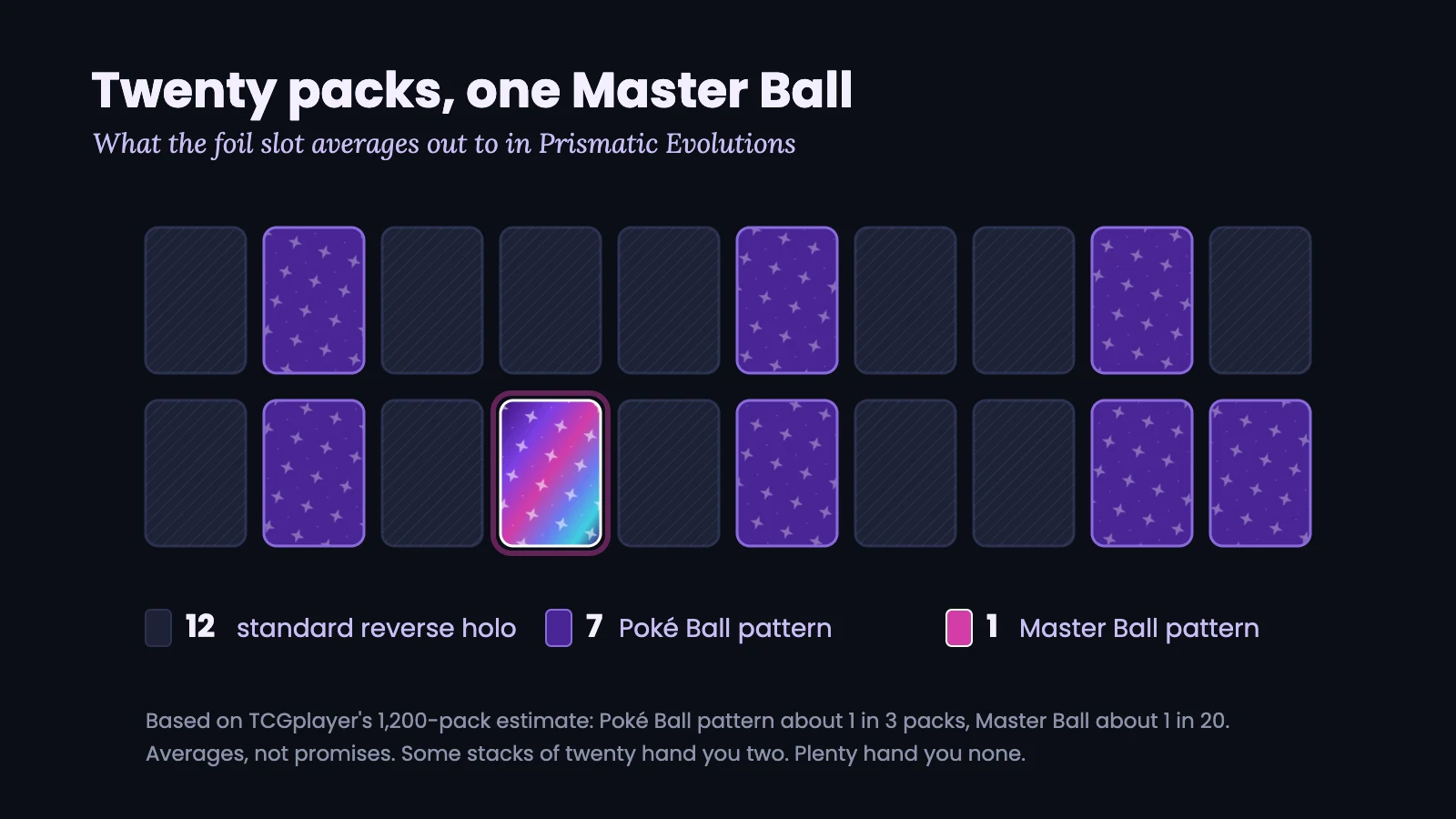
The Pokémon Company officially calls them premium parallel cards, and they almost always come with a little sibling: the Poké Ball pattern. Same idea, humbler ball, much easier to pull. So in these sets there are really three tiers of reverse holo: the standard one, the Poké Ball one, and the Master Ball one sitting on the top step like a Champion waiting for challengers.
These special cards first made a splash in the Japanese Pokémon Card 151 set back in June 2023. And let me tell you, the community went wild. Suddenly, cards that might have been overlooked were transformed into coveted collectibles. It’s like finding out your quiet neighbor is secretly a superhero. A very cool surprise! (Quick heads up for English collectors: our version of 151 never got them. In that set, Master Balls were a Japan-only treat.)
Track Your TCG Collection
Create your free Card Codex account to monitor card prices, view real-time market trends, and analyse your portfolio’s growth.
Start Tracking Now — It’s FreeHow Rare Are We Talking?
Now, I know what you’re thinking. “Okay, they look cool, but are they rare?” The short answer is: you betcha. The longer answer is that it depends on which set you’re opening, and which language it’s printed in.
In Japanese Pokémon Card 151, every 20-pack booster box contains exactly one Master Ball card, picked at random from 153 possibilities. English sets don’t do guaranteed boxes (and neither English Master Ball set was ever sold in booster boxes anyway), so we lean on big opening studies instead. TCGplayer’s 1,200-pack look at Prismatic Evolutions put Master Balls at roughly 1 in 20 packs, and Black Bolt and White Flare landed almost exactly on top of that at about 1 in 19.
| Set | Language | Released | How often a Master Ball turns up | Cards that can get one |
|---|---|---|---|---|
| Pokémon Card 151 | Japanese | June 2023 | Exactly one per 20-pack box | 153 |
| Terastal Festival ex | Japanese | December 2024 | Roughly one every one to two 10-pack boxes | Around 100 |
| Prismatic Evolutions | English | January 2025 | About 1 in 20 packs | 67 Pokémon |
| Black Bolt & White Flare | Japanese | June 2025 | One per box | Non-ex Pokémon |
| Black Bolt & White Flare | English | July 2025 | About 1 in 19 packs | Non-ex Pokémon |
Japanese rates come from box contents and box-break reports. English rates are estimates from large opening studies, because The Pokémon Company doesn’t publish official odds.
Here’s the catch, though. Pulling a Master Ball is one thing. Pulling the Master Ball you want is a whole different boss fight.
In Japanese 151, the odds of a specific card are 1 in 153 boxes, which works out to around 3,060 packs. Prismatic Evolutions spreads its Master Ball rate across 67 different Pokémon (Trainers in that set stop at the Poké Ball version), so any one of them averages out at roughly 1,340 packs. Black Bolt and White Flare are meaner still, at somewhere around 2,800 packs for one particular card.
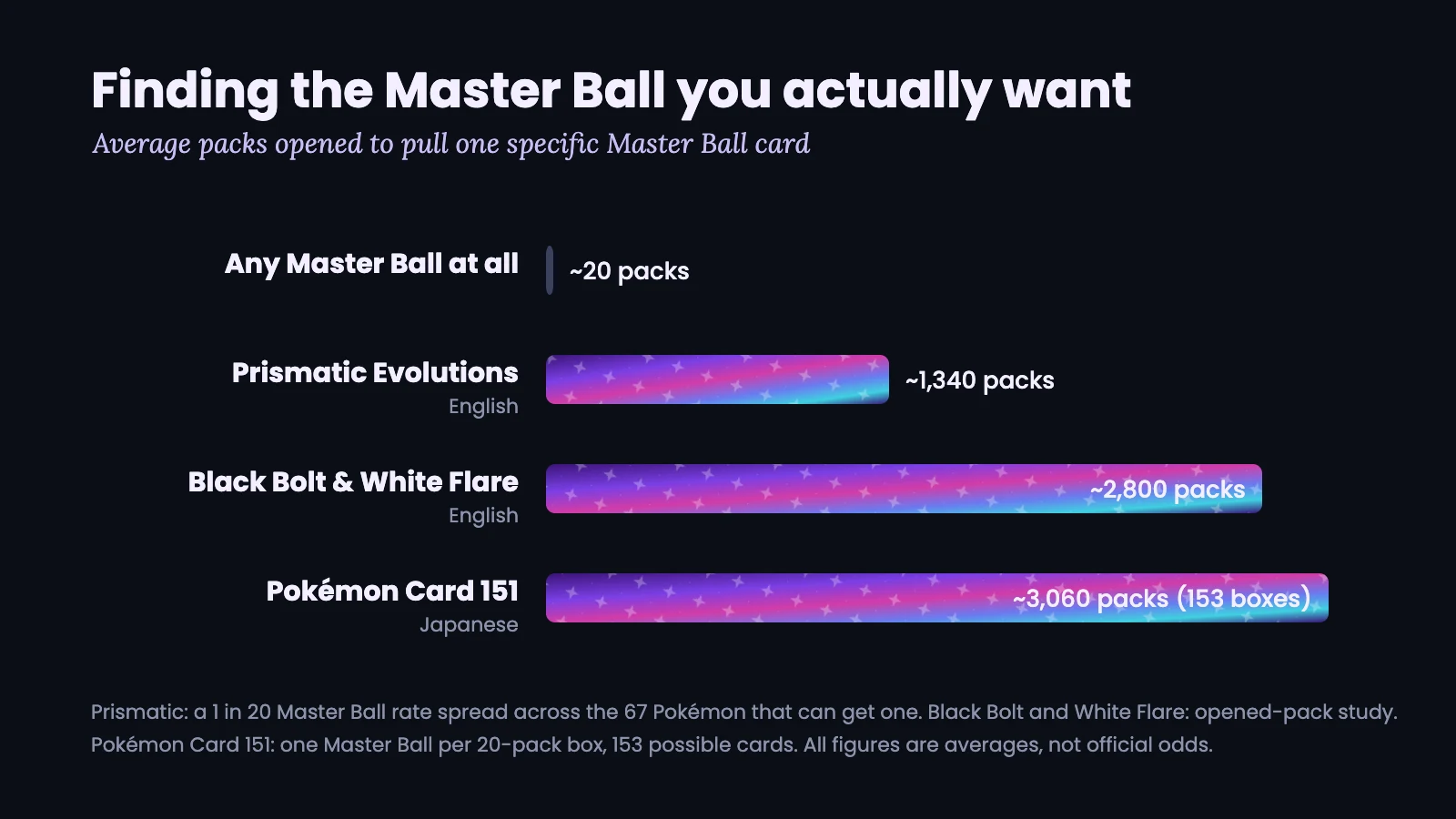
It’s not quite a God Pack level of rarity, but it’s certainly a chase that gets the heart racing!
This rarity is a huge part of their appeal. It adds a whole new layer to completing a Master Set, and for those of us who love the thrill of the chase, what could be better? (Okay, a slightly smaller credit card bill could be better. But you get the idea.)
Where Can You Find These Elusive Cards?
When I first wrote this guide, Master Ball cards were basically a Japanese exclusive. That’s not the case anymore. Here’s the full roll call so far.
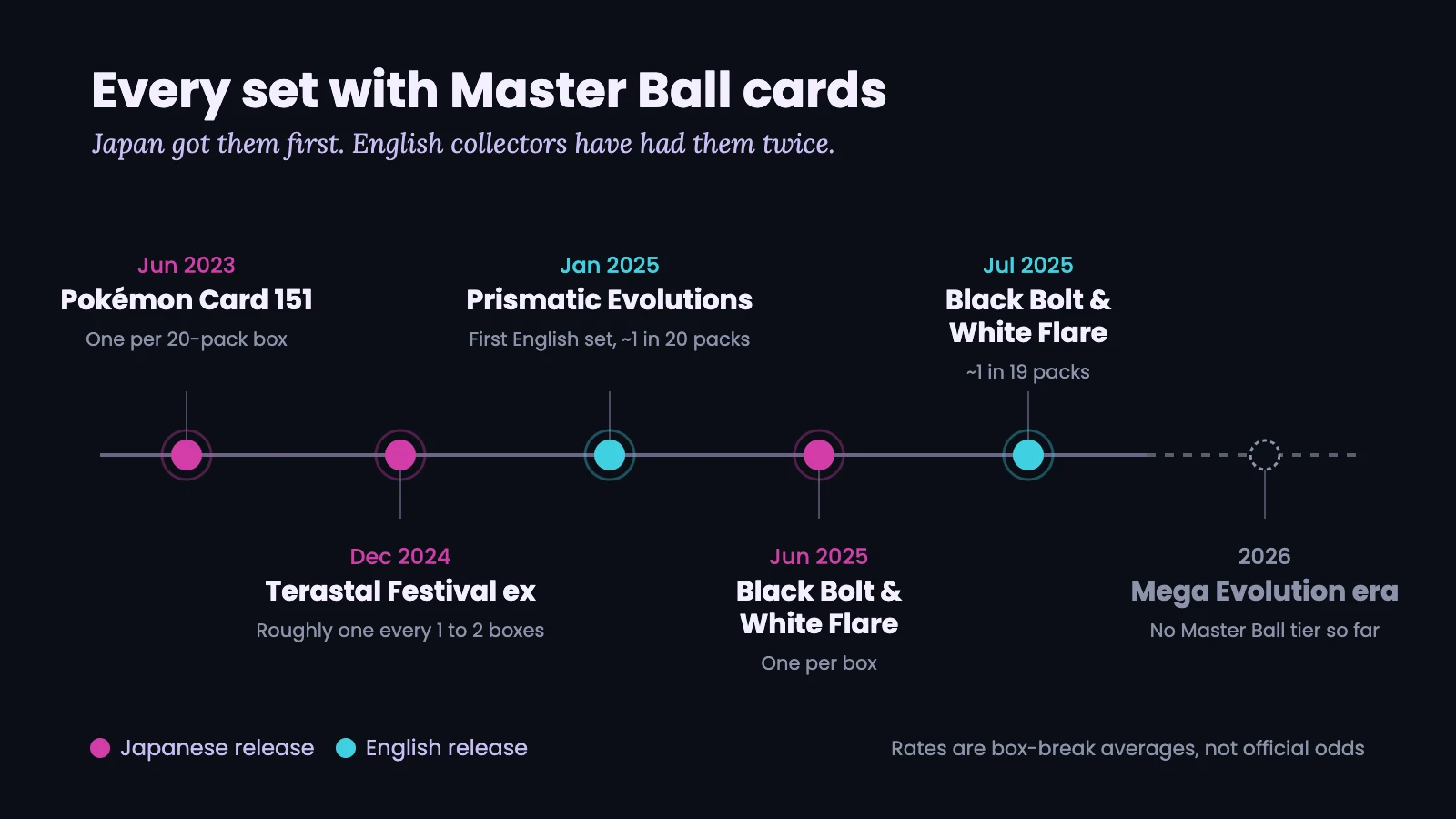
Japan has had three goes at it. Pokémon Card 151 started the party in 2023. Terastal Festival ex followed in December 2024, although there a Master Ball isn’t guaranteed in every box. Then the Japanese Black Bolt and White Flare arrived in June 2025 with one Master Ball promised per box.
English collectors got their first taste with Prismatic Evolutions in January 2025, and I’m convinced the Master Balls were one of the reasons that set turned into such a frenzy. Six months later, Black Bolt brought them back alongside its twin set, White Flare, and the whole Unova crew got the Master Ball treatment. If you want every tier from that release, our Black Bolt and White Flare pull rates post has the lot.
And since then? Silence. The Mega Evolution era has gone in a different direction. Ascended Heroes gives non-ex Pokémon a second reverse holo with themed Poké Balls instead, exactly like Japan’s MEGA Dream ex, with no Master Ball tier sitting on top. And 30th Celebration skips reverse holos altogether, because every card in the pack is already foil.
So for now, Master Ball cards are very much a Scarlet & Violet thing. I wouldn’t bet against them coming back for a future special set, and the second they do, you’ll hear about it here.
Which Master Ball Cards Are Worth the Most?
Let’s be real, a big part of the appeal is the “wow” factor. The Master Ball pattern is a fantastic nod to the games and just looks plain awesome. And in a world of increasingly complex card rarities and symbols, the straightforward coolness of a Master Ball card is a breath of fresh air.
But it’s not just about looks. These cards have properly shaken up the collecting scene. Suddenly a humble common can outsell the shiny ex sitting in the same set, all thanks to that special holographic pattern.
Japanese 151 is where the big money lives. The Gengar Master Ball (094/165) is the set’s headline chase, with raw copies changing hands for around $500 earlier this year. The Pikachu Master Ball (025/165) isn’t far behind, with the cheapest raw copies listed at roughly $350 in September 2026. That’s a common Pikachu. A common! Pikachu really does just keep winning.
In English, all eyes are on the Umbreon Master Ball (059/131) from Prismatic Evolutions. It’s a plain rare, not even an ex, and it still outprices a fair few of the set’s Special Illustration Rares. Umbreon fans truly are a force of nature.
This has led to some interesting market trends, with some Japanese Pokémon cards fetching surprisingly high prices next to their English cousins. These prices move fast, so if you’re hunting one, set up a price alert and let the market come to you instead of panic-buying at the peak.
How to Tell You’ve Actually Pulled One
So you’ve cracked a pack and something purple is winking at you from the reverse slot. Before you start doing victory laps around the living room, check three things.
Where’s the shine? Just like any reverse holo, the pattern lives in the background and the frame, while the artwork window stays clean. If the art itself is holo, you’re looking at a different kind of card entirely.
What’s in the pattern? A Master Ball card is etched with, you guessed it, Master Balls. If it’s the classic red-and-white ball, you’ve got the Poké Ball version: lovely, but far more common. And if you’re opening Ascended Heroes, the fancy Balls you’re seeing are their own pattern, not a Master Ball in disguise.
Don’t trust the number. Master Ball cards share the exact same card number as the regular print, so the number alone won’t tell you a thing. That’s also why scammers love them: slip a regular reverse holo into a “Master Ball” listing and a buyer squinting at a blurry photo might never notice. Always ask for clear photos under good light, and brush up on how to identify fake Pokémon cards before you hand over real money.
Are Master Ball Cards the Same as Parallel Set Cards?
That’s a great question! While they might seem similar, they aren’t quite the same as a traditional “Parallel Set.” A parallel set is typically a complete set of cards with a different holographic pattern or stamp. Master Ball cards are a parallel in the technical sense (that’s literally what The Pokémon Company calls them), but they never cover a whole set. Pokémon ex don’t get one, and in Prismatic Evolutions the Trainers stop at the Poké Ball version.
Think of it this way: a parallel set is like a whole new outfit for every Pokémon in the set, while a Master Ball card is like a super-exclusive, designer accessory for a select few.
Should You Rip Packs Hunting One?
My honest take? If there’s one specific Master Ball you’re after, buy the single. Look back at those numbers. Thousands of packs for a particular card isn’t a hunt, it’s a lifestyle choice, and your wallet will faint faster than a Magikarp out of water.
Open packs for the fun of the surprise, and treat any Master Ball that tumbles out as a glorious bonus. That way, every purple flash in the reverse slot feels like a win instead of a sunk cost.
Are Master Ball Cards Worth the Hype?
As a passionate collector, my answer is still a resounding yes! Master Ball cards are a fantastic addition to the Pokémon TCG. They’re a fun, exciting, and visually stunning type of card to hunt for. They’ve breathed new life into the reverse holo slot, given commons and uncommons a genuine shot at chase-card status, and handed us a whole new reason to get excited about opening packs.
Whether they turn up again in the Mega Evolution era or stay a Scarlet & Violet legend, the ones already out there aren’t getting any easier to find. If you’ve pulled one, sleeve it, frame it, and maybe tell everyone you know. You’ve earned it.