

So, you’ve stumbled into the glittering world of gold Pokémon cards. Maybe you pulled one from a pack and your heart skipped a beat, or perhaps you saw a picture of a gleaming metal Charizard and thought, “I need that.” Whatever your story, you’ve come to the right place. Welcome to the shiniest, most prestigious corner of the Pokémon TCG universe!
But let’s be real, the term “gold card” gets thrown around a lot, and it has only got more confusing since the Mega Evolution era arrived and quietly changed what the top of the rarity ladder even looks like. Are we talking about tournament-legal cards? Those heavy metal ones? The new gold Megas everyone is losing their minds over? And what about those suspiciously cheap, all-gold decks flooding online marketplaces?
Don’t worry. We’re going to break it all down in a way that’s fun, informative, and saves you from making a costly mistake. Think of me as your personal Pokédex for all things gold.
The Golden Range
First things first, “gold card” isn’t one single thing. It’s a catch-all term for a few different types of Pokémon card, each with its own story and purpose. Here’s the quick version before we get into the weeds.
| What people call it | What it actually is | Pack-pullable? | Worth real money? |
|---|---|---|---|
| Hyper Rare (Gold Secret Rare) | Fully gilded, textured TCG card numbered past the set count | Yes | Sometimes, depends entirely on the character |
| Mega Hyper Rare | The Mega Evolution era’s gold tier, the rarest modern pull | Yes, barely | Yes |
| Gold Star card | 2004 to 2007 subset with a gold star by the name. Not actually gold | Historically yes | Enormously |
| Official metal card | Solid metal display replica from a premium box | No, box exclusive | Modestly |
| Burger King gold-plated “card” | 1999 gold-plated metal plaque in a Poké Ball | No | Novelty money |
| The AliExpress special | Unlicensed gold-coloured metal, not a Pokémon card at all | No | Absolutely not |
Six things people mean by “gold Pokémon card.” Only three of them are official TCG products. All prices in this article are in US dollars.
Official TCG Gold Cards (Hyper Rares)
These are the treasures you can actually pull from a booster pack (if you’re very, very lucky!). They are fully playable, tournament-legal cards that The Pokémon Company releases at its highest rarity tiers, a category packed with its own unique symbols and pull rates, formerly known as “Secret Rares” and now called “Hyper Rares.”
You’ll know one when you see it:
- The Look: The entire face of the card is covered in a gorgeous, textured gold foil that shimmers in the light. It’s not just a flat color; you can often feel the pattern with your fingertip.
- The Number: It’s a “Secret Rare,” meaning its collector number is higher than the set’s official count (like 211/202). This is the card’s way of telling you it’s a special, hidden find!
- The Symbol: Three gold stars in the bottom corner. CGC’s rarity guide lays out the whole symbol family if you want the full chart.
These cards first made their grand entrance during the Black & White era, with the legendary Reshiram and Zekrom from the Legendary Treasures set in 2013 being the first to get the full-gold treatment. Since then they’ve become a staple of the high-rarity chase, applied to powerful Pokémon, essential Trainer cards, and even Energy cards.
Here’s the bit that trips people up in 2026, though. The three-gold-star Hyper Rare is a Scarlet & Violet thing. The mainline Mega Evolution sets don’t print them any more.
Mega Hyper Rares: The New King of Gold
When Mega Evolution Base landed in September 2025, it brought a brand new rarity with it, and it sits above everything that came before. Meet the Mega Hyper Rare.
These are fully gold-embossed cards showing a front-facing Mega-Evolved Pokémon, and crucially, the artwork is original. It isn’t a gold repaint of the full art you already have. They carry their own rarity symbol rather than the familiar three stars, so if you’re squinting at the bottom corner wondering why it doesn’t match anything on the old chart, that’s why.
Now the number that made the community collectively wince. Community data compiled from thousands of pack openings puts the Mega Hyper Rare at roughly 1 in 1,260 packs. To put that in perspective, Wargamer noted that the Hyper Rares these replaced were turning up around 1 in 149 packs in Destined Rivals. That’s roughly an order of magnitude harder.
You would need to rip about 35 booster boxes, on average, to see one.
Each Mega-era set has had one or two. Mega Evolution Base gave us gold Mega Lucario ex and gold Mega Gardevoir ex. Phantasmal Flames capped its numbering with gold Mega Charizard X ex. Perfect Order closed out with a single gold Mega Zygarde ex. If you want the granular odds, we’ve broken them down set by set, starting with our Mega Evolution Base pull rates.
One more wrinkle. When Ascended Heroes arrived in January 2026, The Pokémon Company added Mega Attack cards to the top tier: full-art Megas with their signature attack rendered in kanji, marked by two pastel stars, one pink and one green. They sit alongside the Mega Hyper Rares in scarcity but they are not gold. Lovely cards. Just don’t go hunting for gold and expect to find them.
My honest take? The Mega Hyper Rare is the most exciting thing to happen to gold cards in a decade, and also the most frustrating. The art is genuinely new instead of recycled, which is a real upgrade. But at 1 in 1,260 you are not pulling one. You are buying one. Make peace with that early and you’ll enjoy the era a lot more.
Gold Star Cards (The Gold Cards That Aren’t Gold)
Here’s the one that catches everybody out. Search “gold Pokémon card” and a huge slice of the results are talking about something with almost no gold on it at all.
Gold Star cards ran from 2004 to 2007 across the EX era. They’re marked by a small gold star next to the Pokémon’s name, and the Pokémon itself is rendered in shiny alternate colouring. The card stock is normal. The border is normal. It is not a gold card in the way a Hyper Rare is a gold card.
It is, however, where the real money lives.
The Charizard Gold Star from EX Dragon Frontiers is the crown jewel, and it has gone absolutely vertical. Sports Illustrated reported that a PSA 10 crossed six figures at $100,000 in February 2026, up from a previous high of $65,600 the previous December, against a population of fewer than 100 gem copies. The Pikachu Gold Stars and Torchic Gold Stars have both posted six-figure results in the same window.
So if someone tells you they’ve got a “gold Charizard,” it is worth asking which one they mean. The gap between a modern Hyper Rare and a Gold Star is roughly the gap between a nice dinner and a house deposit.
Official Metal Cards
In 2021, for Pokémon’s 25th anniversary, we got something entirely new: official metal cards. These are beautiful, high-quality replicas of iconic cards, but let’s be crystal clear: they are not playable TCG cards. They’re heavier, thicker, and meant for display only.
They only ever come in high-end premium boxes, and there still aren’t many of them. Here’s the complete list as it stands.
| Metal card | Product | Released |
|---|---|---|
| Base Set Pikachu | Celebrations Ultra-Premium Collection | October 2021 |
| Base Set Charizard | Celebrations Ultra-Premium Collection | October 2021 |
| Arceus V | Arceus VSTAR Ultra-Premium Collection | November 2022 |
| Arceus VSTAR | Arceus VSTAR Ultra-Premium Collection | November 2022 |
| Mew ex | 151 Ultra-Premium Collection | October 2023 |
| Tera Greninja ex | Greninja ex Ultra-Premium Collection | November 2024 |
Every official metal card released by The Pokémon Company to date. The Celebrations pair are gold-faced; the rest are full colour.
That last row is the update most articles still haven’t caught up with. The Greninja ex Ultra-Premium Collection shipped in November 2024 at $119.99 as a GameStop exclusive, and it included Greninja as both a playable card and a metal collectible. So the count is six, not five.
Worth knowing: the metal card is not an automatic feature of every premium box. The Mega Charizard X ex Ultra-Premium Collection from November 2025 is a $119.99 flagship product and it contains no metal card at all, just etched foil promos and a metal coin. If you’re buying a box specifically for the metal, read the contents list first.
Anything else you see is an unofficial product, no matter how cool it looks.
Burger King’s Gold-Plated “Cards”
Believe it or not, the very first “gold” Pokémon collectibles came from a Burger King promotion back in 1999 for Pokémon: The First Movie. For an extra $1.99 with your meal, you could get a 23-karat gold-plated metal “card” housed in a fancy, spring-loaded plastic Poké Ball, complete with a certificate of authenticity.
There were six in the run: Charizard, Pikachu, Jigglypuff, Mewtwo, Poliwhirl and Togepi. These weren’t TCG cards but more like small metal plaques. They’re a fun, nostalgic piece of Pokémon history that many collectors still seek out today, and because millions were made, sealed ones are usually a tens-of-dollars proposition rather than a life-changing one.

Track Your TCG Collection
Create your free Card Codex account to monitor card prices, view real-time market trends, and analyse your portfolio’s growth.
Start Tracking Now — It’s FreeIs My Gold Card Valuable?
Okay, let’s get to the big question. While there are many factors that make a Pokémon card valuable, a gold card’s worth is a cocktail of a few key ingredients, and understanding them is what separates a casual fan from a savvy collector.
- The Pokémon “Cool Factor”: Let’s call this the Charizard Tax. Some Pokémon are just rock stars, and their cards will always be worth more. A gold card featuring Charizard, Pikachu, Mewtwo, or a popular Eeveelution like Umbreon will almost always command a higher price than a less popular Pokémon of the same rarity. It’s all about that nostalgia and star power!
- Rarity and Pull Rates: This is simple supply and demand. The Pokémon Company doesn’t publish official odds, but community datasets running to thousands of packs have put Scarlet & Violet era Hyper Rares somewhere in the region of 1 in 130 to 1 in 190 packs depending on the set, and Mega Hyper Rares out at roughly 1 in 1,260. The harder a card is to find, the more someone is willing to pay for it.
- Playability: If a gold card is also a staple in competitive decks (like an Ultra Ball or a Rare Candy), its value gets a major boost from players who want to “max-rarity” their deck for tournaments. Worth noting for 2026: the current Mega sets aren’t printing gold Trainers, so the existing Scarlet & Violet golds are a closed pool. That’s quietly supportive for the good ones.
- Condition is King: Understanding Pokémon card conditions is crucial, as an unblemished, perfect card is exponentially more valuable than one with whitening on the edges or a tiny scratch. Gold cards are particularly brutal here, because the etched foil shows every scuff under a grader’s light. The difference between a PSA 9 and a PSA 10 can mean hundreds or even thousands of dollars for a high-end card, and our grading cost breakdown will tell you whether the maths works before you post anything off.
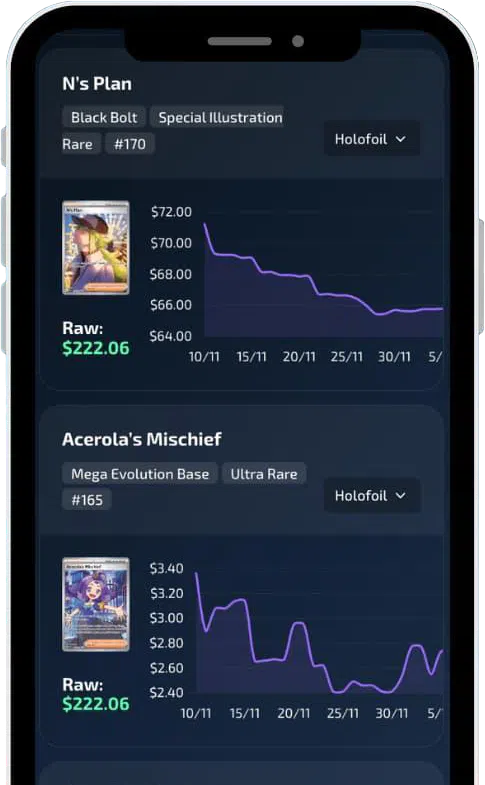
If you want to stop guessing, point our card value scanner at it and get a live market read in a couple of seconds. Then drop it into your collection and let it track itself.
The AliExpress Special: Fake Gold Cards
Now for a crucial public service announcement. Have you seen those ads for a box of 55 gold foil Pokémon cards for a few dollars? They’re all over AliExpress, Temu, and the murkier corners of eBay, and they are 100% fake.
And this is not a small problem any more. PSA’s 2025 Fraud Report, published in May 2026, estimated the company intercepted more than $200 million in projected market value of fraudulent collectibles in a single year. Pokémon accounted for 56.3% of the counterfeit trading cards PSA encountered, with Pokémon counterfeit submissions up over 125% year on year. PSA’s president has since said publicly that the $200 million figure was deliberately conservative.
Translation: the fakes are not just the obvious tat any more. They are getting good.
Here’s how to spot the bulk gold counterfeits:
- The Price is Too Good to Be True: A full box of what looks like ultra-rare cards for under $20? That’s your first and biggest red flag. Real gold cards are rare and expensive for a reason.
- The Look and Feel: They are often made of cheap metal or plastic with a gold-colored coating. While they might feel heavy, they lack the specific, detailed texture and high-quality print of a real card.
- The Back of the Card: This is a dead giveaway. Many of these fakes have a shiny gold back. An official Pokémon card, whether it’s cardstock or one of the six official metal cards, will always have the classic blue-and-white Pokémon card back design.
- The Energy Symbols: Replicas frequently render every energy icon in flat gold with no colour. Real gold cards keep the energy symbols legible and coloured because, well, you’re supposed to be able to play the thing.
- The Marketing Language: Sellers often use vague terms like “metal cards,” “gold foil,” or “custom cards” to avoid saying they are official.
These cards can be a fun, cheap novelty for kids who don’t know the difference, but they have zero collector value and are not legal for any official play. Don’t get tricked into thinking you’ve found a secret treasure trove. The real treasure is knowing how to spot a fake from a mile away, a crucial skill to avoid Pokémon card scams.
How to Spot a Fake Like a Pro
Beyond the obvious bulk fakes, you still need to be careful when buying or trading single cards. Here’s a quick checklist to keep in your back pocket, and our full guide on how to identify fake Pokémon cards goes deeper on every one of these.
- Check the Font and Spelling: Fakes often have typos, weird spacing between letters, or use the wrong font. A classic error is forgetting the accent on the “é” in “Pokémon.”
- Look at the Colors and Print Quality: A real card has sharp, vibrant colors. Fakes often look washed-out, blurry, or the blue on the back is the wrong shade (often too light or purplish). A 10x loupe will show you the rosette dot pattern on a genuine print.
- Feel the Texture: Modern gold cards have a distinct, physically raised texture you can feel with your finger. Most fakes are completely smooth and glossy.
- Do the Light Test: Shine a bright light (like your phone’s flashlight) through the card. A real card is made of layered cardstock with a dark core and will only let a dim, diffuse glow through. Many fakes are either totally opaque or let way too much light through.
- Check the Number Against a Real Set List: This one is easy to skip and it catches a lot. If a card claims to be 188/132 from Mega Evolution Base, that number needs to actually exist.
And if the card is worth real money, grading settles the argument permanently. That’s the point of it.
Go Forth and Collect!
Navigating the world of gold Pokémon cards is a thrilling part of the hobby. They represent the peak of rarity and design, a true trophy for any collection. Now you have the knowledge to tell the difference between a priceless treasure and a worthless trinket.
Whether you’re hunting for that one Mega Hyper Rare to complete your master set, investing in a graded vintage slab, or even deciding where to sell your Pokémon cards, the most important thing is to have fun. And if you’ve got a specific gold card in your sights, set a price alert so you’re the one who hears about the dip first.
Happy collecting, and may your next pack have a little bit of gold in it!
Your Gold Card Questions, Answered! (The FAQ Section)
Still have a few questions rattling around in your brain? Perfect. Let’s tackle some of the finer points that can make all the difference in your collecting journey.
Q: What’s the difference between a Hyper Rare and a Mega Hyper Rare?
A: Great question, and the one I get asked most since the era flipped over. A Hyper Rare is the classic gold card: three gold stars, fully gilded, and it’s usually a gold version of artwork you’ve already seen elsewhere in the set. It could be a Pokémon, a Trainer, or an Energy. A Mega Hyper Rare is exclusive to Mega Evolution Pokémon ex, has completely original artwork rather than a gold repaint, carries its own rarity symbol instead of the three stars, and is roughly ten times harder to pull. The simplest tell in your hand: if it’s gold and it’s a Trainer card, it’s a Hyper Rare from the Scarlet & Violet era. The Mega sets don’t print those.
Q: I have a gold card, should I get it graded immediately?
A: Hold your Rapidash! Grading isn’t always the automatic next step. It costs money and takes time, so you need to be strategic. Ask yourself: Is this a high-value Pokémon like a Charizard, or a super popular Trainer card? Is it in absolutely pristine, pack-fresh condition (no whitening, perfect centering)? If the answer is yes to both, grading could significantly boost its value. However, if it’s a less popular Pokémon or has even a tiny bit of wear, the cost of grading might be more than the value it adds. For your absolute top-tier pulls, it’s a no-brainer. For others, it’s perfectly fine to just love them in a high-quality sleeve and top-loader. Our guide on pre-grading your cards will help you make the call honestly.
Q: Why are some of the most valuable gold cards… an Ultra Ball or a Switch?
A: It seems wild, right? You pull a glorious golden Pokémon, and it’s worth less than a common item! Welcome to the world of competitive play. An Ultra Ball, a Rare Candy, or a Professor’s Research are cards used in almost every top-tier deck. Players who want to add the maximum amount of “bling” to their deck for tournaments (a practice lovingly called “max-rarity”) will pay top dollar for the shiniest, rarest versions of these essential cards. These are often considered the top chase cards of a set. One thing that has changed: with the Mega sets not printing gold Trainers, the supply of new ones has stopped for now. If a gold Trainer stays format-legal and stays good, that’s a squeeze waiting to happen.
Q: What about gold cards from Japan? Are they the same?
A: An excellent question for a discerning collector! Japanese cards are often the “Original Generation,” releasing before their English counterparts. Their gold cards look very similar, but with Japanese text and a different rarity code. What we call a Hyper Rare is a UR in Japan, and the Mega Hyper Rare is a Mega Ultra Rare, or MUR. The key difference can be in the texture and holo pattern, sometimes subtly different, which is like catnip for the most dedicated collectors. The debate over whether Japanese or English cards are worth more is a common one, and value-wise they can be just as valuable, especially when graded. Think of them as the first edition of a legendary book.
Q: I’ve seen cards with a gold border and a player’s signature on the back. What are those?
A: Ah, you’ve spotted a World Championship card! These are special, non-holographic replicas of decks used by top players at the annual World Championships. They have a unique card back (often with a player’s signature and the year) and are not tournament-legal for standard play. While their borders are often gold or silver, they aren’t the full-art textured gold foil cards we’ve been talking about. They’re a cool, affordable way to study what the pros play, but they don’t carry the same collector value as a pack-pulled Secret Rare.
Q: How should I store these fancy cards to keep them safe?
A: You wouldn’t leave a legendary Pokémon out in the rain, would you? Same principle! The gold standard (pun intended) for protection is the triple-threat combo: first, a “perfect-fit” sleeve, then a standard “penny” sleeve over that, and finally, slide it into a rigid top-loader. For your absolute crown jewels, that Charizard or Mewtwo, consider a magnetic “one-touch” case for a premium display. Once they’re safe, you can think about the best ways to sort and organize your Pokémon cards, and if you want them on the wall rather than in a box, our guide to displaying your holy grails covers UV protection properly. The goal is to protect them from dust, scratches, and the arch-nemesis of all cards: UV light, which can fade that beautiful gold shimmer over time. Keep them out of direct sunlight!